English can feel tricky when two terms look almost identical but work differently in sentences. One of the most common examples is “awhile vs a while.” Many writers pause when deciding whether to use the one-word version or the two-word phrase. If you have ever wondered which one is correct, you are definitely not alone.
The confusion usually happens because both expressions relate to time. However, they do not function the same way grammatically. Understanding the difference can instantly improve your writing, make your emails sound more polished, and help you avoid common grammar mistakes in school, work, or everyday communication.
In this guide, you will learn the meaning of “awhile” and “a while,” when to use each one, examples, grammar rules, common mistakes, and simple memory tricks to help you remember the difference forever.
Quick Answer
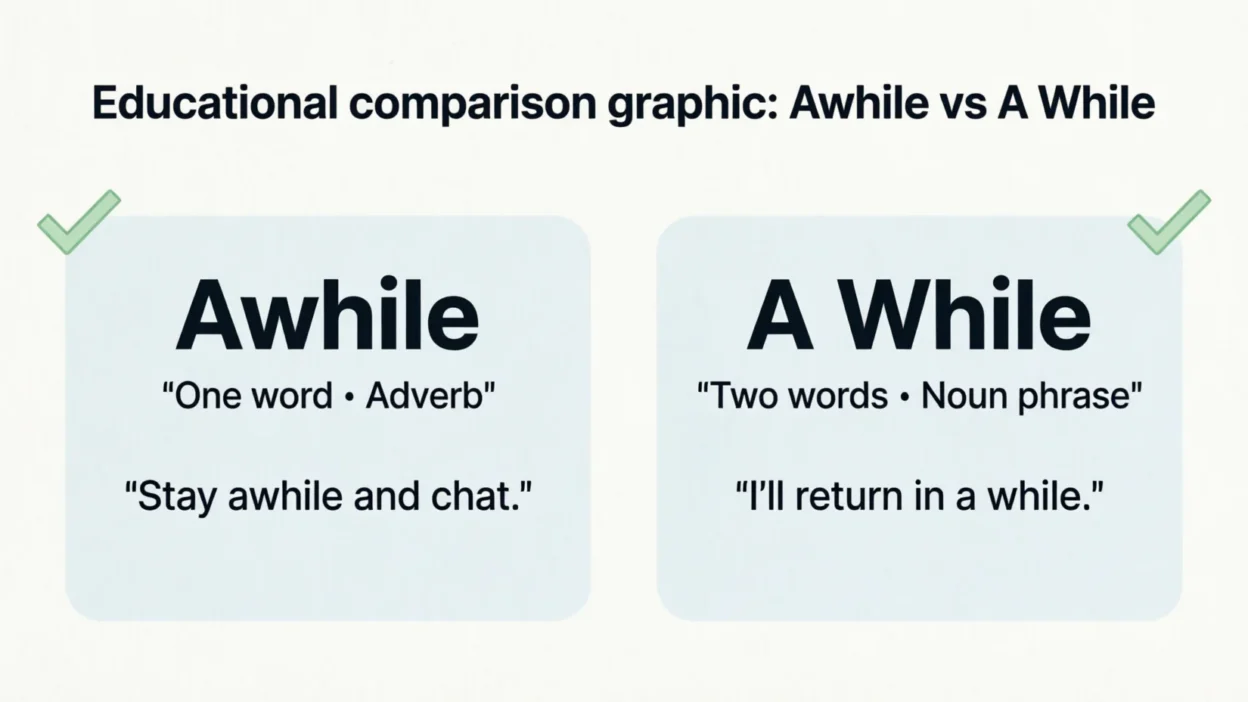
“Awhile” is an adverb that means “for a short time,” while “a while” is a noun phrase that refers to a period of time. Use “awhile” without a preposition and use “a while” after prepositions like “for” or “in.”
What Does “Awhile” Mean?
“Awhile” is a single-word adverb. It means “for a short time” or “temporarily.”
Because it is an adverb, it modifies a verb. It usually appears directly after action verbs without needing extra words.
Examples of “Awhile”
- Please stay awhile.
- Sit awhile and relax.
- They talked awhile after dinner.
- The baby slept awhile before waking up.
In all these examples, “awhile” describes how long the action lasted.
Easy Grammar Rule
If the sentence works naturally without adding “for,” then “awhile” is usually correct.
Correct:
- Wait awhile.
Incorrect:
- Wait for awhile.
Although “for awhile” appears in casual writing sometimes, many grammar experts prefer “for a while.”
What Does “A While” Mean?
“A while” is a noun phrase. The word “while” acts as a noun meaning “a period of time.”
Because it is a noun phrase, it often follows prepositions such as:
- for
- after
- in
- quite
- a long
Examples of “A While”
- We waited for a while.
- It has been a while since we met.
- She rested for a while.
- I haven’t seen him in a while.
Here, “a while” functions as an object in the sentence rather than describing an action directly.
Awhile vs A While Comparison Table
| Feature | Awhile | A While |
|---|---|---|
| Part of speech | Adverb | Noun phrase |
| Meaning | For a short time | A period of time |
| Used after prepositions? | No | Yes |
| Common structure | Verb + awhile | Preposition + a while |
| Example | Stay awhile | Stay for a while |
When to Use “Awhile”
Use “awhile” when you need an adverb that directly modifies the verb.
Common Sentence Patterns
- Rest awhile.
- Wait awhile.
- Stay awhile.
- Relax awhile.
More Practical Examples
- Let’s sit awhile by the fire.
- The kids played awhile before dinner.
- He paused awhile before answering.
- We walked awhile in silence.
Helpful Tip
You can often replace “awhile” with “briefly” or “temporarily.”
Example:
- Stay awhile.
- Stay briefly.
If the replacement works, “awhile” is probably correct.
When to Use “A While”
Use “a while” when the sentence needs a noun phrase referring to time.
Common Sentence Patterns
- for a while
- after a while
- in a while
- quite a while
More Practical Examples
- We talked for a while after class.
- I will see you in a while.
- After a while, the rain stopped.
- It took a while to finish the project.
Helpful Tip
If you can replace the phrase with “a period of time,” then “a while” is likely correct.
Example:
- We waited for a while.
- We waited for a period of time.
The sentence still makes sense.
Common Mistakes People Make
Many English learners and even native speakers mix these terms because they sound almost identical in conversation.
Here are the most common mistakes.
Mistake 1: Using “for awhile”
Incorrect:
- We stayed for awhile.
Preferred:
- We stayed for a while.
Why?
The preposition “for” should usually be followed by the noun phrase “a while.”
Mistake 2: Splitting “awhile” Incorrectly
Incorrect:
- Stay a while here.
This sentence is not always wrong, but it slightly changes the structure. “Stay awhile” sounds smoother and more natural in many contexts.
Mistake 3: Treating Both Forms as Interchangeable
Incorrect:
- Wait a while quietly.
Better:
- Wait awhile quietly.
Here, the sentence needs an adverb, not a noun phrase.
Simple Memory Trick for Awhile vs A While
A quick trick can make this easy forever.
Use “Awhile” Without Prepositions
If there is no preposition before the term, use “awhile.”
Example:
- Stay awhile.
Use “A While” After Prepositions
If you see words like “for,” “after,” or “in,” use “a while.”
Examples:
- for a while
- after a while
- in a while
This simple rule works most of the time.
Awhile vs A While in American and British English
Both American English and British English use “awhile” and “a while” similarly. There is no major regional difference in grammar rules.
However, modern casual writing in both regions sometimes bends the rules. You may occasionally see “for awhile” online, especially in blogs, social media posts, or informal messages.
Professional writing, academic writing, and edited publications still prefer:
- awhile
- for a while
So if you want your writing to look polished and grammatically correct, following the traditional distinction is best.
Real-Life Example Paragraphs
Understanding grammar becomes easier when you see words used naturally.
Example Using “Awhile”
After finishing the meeting, everyone stayed awhile to chat about the upcoming event. The relaxed conversation helped the team feel more connected and comfortable.
Example Using “A While”
After the presentation, the employees talked for a while about new ideas for the project. It took a while before everyone finally headed home.
These examples show how the sentence structure changes depending on the phrase used.
Synonyms and Related Phrases
Learning related words can improve your vocabulary and help with SEO understanding too.
Synonyms for “Awhile”
- briefly
- temporarily
- momentarily
- shortly
Synonyms for “A While”
- some time
- a period of time
- several minutes
- a short duration
Related Grammar Searches
People searching for “awhile vs a while” also often search for:
- everyday vs every day
- setup vs set up
- onto vs on to
- sometime vs some time
- anyone vs any one
These pairs create similar grammar confusion because spacing changes the function of the words.
Placement and Grammar Rules Table
| Phrase | Sentence Placement | Tone | Example |
|---|---|---|---|
| Awhile | Usually after verbs | Neutral and natural | Please stay awhile |
| A While | Often after prepositions | Neutral and formal | We stayed for a while |
| In a while | Future time reference | Conversational | I’ll call you in a while |
| After a while | Indicates delay | Natural | After a while, they left |
| Quite a while | Emphasizes length | Informal to formal | It took quite a while |
Why This Grammar Difference Matters
Small grammar details can make a big difference in how your writing sounds. Correctly using “awhile” and “a while” shows attention to detail and improves readability.
This distinction matters especially in:
- academic writing
- professional emails
- business communication
- blog writing
- content marketing
- school assignments
Readers may not consciously notice correct grammar, but they often notice mistakes.
FAQs About Awhile vs A While
Is “awhile” one word or two?
“Awhile” is one word when used as an adverb. “A while” is two words when used as a noun phrase.
Which is correct: “stay awhile” or “stay a while”?
Both can appear in English, but “stay awhile” is usually preferred because “awhile” functions as the adverb.
Is “for awhile” grammatically wrong?
It is common in informal writing, but most grammar guides prefer “for a while.”
Can I use “awhile” in formal writing?
Yes. “Awhile” is perfectly acceptable in formal and professional English when used correctly.
What does “in a while” mean?
“In a while” means after a short period of time in the future.
Why do people confuse “awhile” and “a while”?
They sound identical when spoken, so many people do not realize they have different grammatical functions.
Is there a British vs American English difference?
No significant difference exists. Both forms follow the same grammar rules in British and American English.
Final Thoughts
The difference between “awhile” and “a while” may seem small, but mastering it can noticeably improve your grammar and writing confidence. “Awhile” works as an adverb, while “a while” functions as a noun phrase connected to a period of time.
The easiest way to remember the rule is simple: if a preposition like “for” or “in” appears before the phrase, use “a while.” Otherwise, “awhile” is usually the better choice. With a little practice, choosing the correct form becomes completely natural.
Actionable Takeaway
Before using either phrase, quickly check the sentence structure. If the phrase follows a preposition, choose “a while.” If it directly modifies a verb, choose “awhile.” This quick grammar habit can instantly make your writing sound cleaner, more professional, and easier to understand.

Fenwick Quentin is a creative blogging author known for his analytical yet engaging writing style.
He explores topics such as innovation, digital culture, and personal development with depth and clarity.
Through his articles, Fenwick encourages readers to think critically and embrace continuous growth.