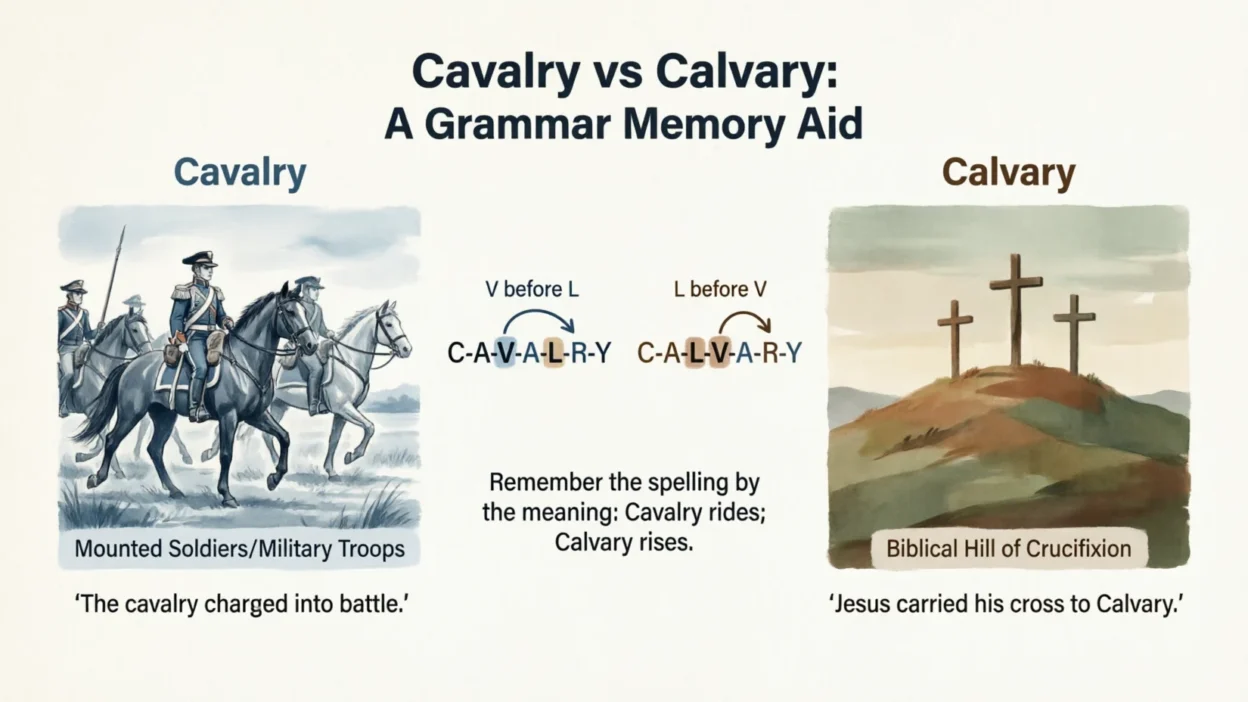
Have you ever seen cavalry and Calvary used interchangeably and wondered if they mean the same thing? You’re not alone. These two words look and sound similar, which makes them one of the most commonly confused word pairs in English.
However, cavalry and Calvary have completely different meanings. One relates to soldiers on horseback, while the other has deep religious significance in Christianity. Understanding the distinction will help you avoid embarrassing mistakes and use each word correctly.
Quick Answer
- Cavalry refers to soldiers who fight on horseback or military units descended from mounted troops.
- Calvary refers to the hill where Jesus Christ was crucified according to the Bible.
Examples:
- The cavalry arrived just in time to help the army. ✅
- Many Christians reflect on the events of Calvary during Easter. ✅
A simple rule:
👉 Cavalry = soldiers
👉 Calvary = crucifixion site
What Does “Cavalry” Mean?
Definition of Cavalry
Cavalry is a noun referring to mounted soldiers or military units that historically fought on horseback.
In modern military contexts, cavalry units may use armored vehicles rather than horses, but the historical term remains.
Examples of Cavalry in Sentences
- The cavalry charged across the battlefield.
- The cavalry arrived as reinforcements.
- Historically, cavalry units played an important role in warfare.
- The general ordered the cavalry to advance.
In each example, the word relates to military forces.
Historical Importance of Cavalry
For centuries, cavalry was one of the most powerful military forces because mounted soldiers could:
- Move quickly
- Cover long distances
- Launch fast attacks
- Pursue retreating enemies
Famous armies throughout history relied heavily on cavalry units.
Modern Use of Cavalry
Today, the term may refer to:
- Armored cavalry units
- Reconnaissance forces
- Military traditions descended from horse-mounted troops
Common Expression: “The Cavalry Is Coming”
This phrase is often used figuratively.
Example:
- Don’t worry—the cavalry is coming.
Meaning:
- Help is on the way.
What Does “Calvary” Mean?
Definition of Calvary
Calvary is the English name for Golgotha, the hill near Jerusalem where Jesus Christ was crucified according to the New Testament.
It is a significant religious term in Christianity.
Examples of Calvary in Sentences
- The sermon focused on the sacrifice made at Calvary.
- Many hymns reference Calvary.
- Christians remember the events of Calvary during Holy Week.
- The church displayed artwork depicting Calvary.
In these examples, the word relates to Christian faith and biblical history.
Religious Significance of Calvary
For Christians, Calvary symbolizes:
- Sacrifice
- Redemption
- Forgiveness
- Salvation
It is one of the most important locations in Christian tradition.
Cavalry vs Calvary: Key Differences
| Feature | Cavalry | Calvary |
|---|---|---|
| Meaning | Mounted soldiers or military unit | Hill where Jesus was crucified |
| Context | Military and warfare | Christianity and religion |
| Origin | Horse-mounted troops | Biblical location |
| Example | The cavalry attacked. | The message of Calvary inspires believers. |
| Common Usage | Military discussions | Religious discussions |
The two words are never interchangeable.
Why People Confuse Cavalry and Calvary
Similar Pronunciation
Many speakers pronounce these words similarly, especially in casual conversation.
Similar Spelling
The difference is only one letter:
- Cavalry
- Calvary
This small spelling change causes frequent errors.
Familiarity Gap
Many people know one word but not the other, leading them to substitute the wrong term.
When to Use Cavalry
Military History
Examples:
- The cavalry played a major role in medieval warfare.
- Napoleon relied heavily on cavalry forces.
Modern Military Units
Examples:
- The cavalry regiment conducted reconnaissance operations.
- The armored cavalry unit moved forward.
Figurative Use
Examples:
- Technical support arrived—the cavalry was here.
- The parents stepped in like the cavalry.
In these cases, cavalry means help or reinforcements.
When to Use Calvary
Religious Writing
Examples:
- The pastor preached about Calvary.
- The hymn celebrated the sacrifice at Calvary.
Biblical Discussions
Examples:
- The events of Calvary are central to Christian theology.
- Pilgrims visit locations associated with Calvary.
Christian Literature
Examples:
- The book explores the meaning of Calvary.
- Artists often depict scenes from Calvary.
Common Mistakes to Avoid
Mistake 1: Using Calvary for Soldiers
Incorrect:
- The calvary arrived to rescue the troops. ❌
Correct:
- The cavalry arrived to rescue the troops. ✅
Soldiers are cavalry.
Mistake 2: Using Cavalry for the Crucifixion Site
Incorrect:
- Jesus was crucified at cavalry. ❌
Correct:
- Jesus was crucified at Calvary. ✅
The biblical location is Calvary.
Mistake 3: Misspelling the Figurative Expression
Incorrect:
- The calvary is coming. ❌
Correct:
- The cavalry is coming. ✅
Help comes from the cavalry, not Calvary.
Real-Life Examples
Example 1
Correct:
- The cavalry crossed the river before dawn.
Incorrect:
- The Calvary crossed the river before dawn.
Example 2
Correct:
- Many Easter services focus on Calvary.
Incorrect:
- Many Easter services focus on cavalry.
Example 3
Correct:
- The cavalry arrived just in time.
Incorrect:
- The Calvary arrived just in time.
Easy Memory Tricks
Cavalry Has a “Horse” Connection
Think of the word cavalier, which is associated with horsemen.
Cavalry = soldiers on horseback
Calvary Contains “Altar” Sounds
Many people associate Calvary with church, faith, and worship.
Calvary = Christian religious site
Quick Reminder
- Cavalry = military
- Calvary = biblical
American vs British English Differences
There is no significant difference between American and British English regarding cavalry and Calvary.
American English
- The cavalry advanced.
- The sermon mentioned Calvary.
British English
- The cavalry advanced.
- The sermon mentioned Calvary.
The meanings and spellings are identical in both varieties.
Related Words and LSI Keywords
When learning cavalry vs Calvary, you may also encounter:
- Mounted soldiers
- Horseback troops
- Military history
- Golgotha
- Christian theology
- Biblical locations
- Easter traditions
- Religious terminology
- Commonly confused words
- English vocabulary
These related terms help provide context for each word.
FAQs About Cavalry vs Calvary
What is the difference between cavalry and Calvary?
Cavalry refers to mounted soldiers, while Calvary refers to the biblical site of Jesus Christ’s crucifixion.
Is cavalry related to horses?
Yes. Historically, cavalry consisted of soldiers who fought on horseback.
What does Calvary mean in Christianity?
It refers to the hill where Jesus was crucified.
Which word means military reinforcements?
Cavalry.
Is “the cavalry is coming” a common expression?
Yes. It means help is on the way.
Can cavalry and Calvary be used interchangeably?
No. Their meanings are completely different.
Why do people confuse these words?
Because they have similar pronunciations and spellings.
Which spelling should I use for a religious context?
Use Calvary.
Final Summary
Understanding cavalry vs Calvary is essential because the two words belong to entirely different contexts. Cavalry refers to mounted soldiers and military units, while Calvary refers to the biblical site where Jesus Christ was crucified. Although their spellings are similar, their meanings are not related.
Most confusion occurs because the words sound alike in conversation. A simple memory trick can help: cavalry is connected to soldiers and horses, while Calvary is connected to Christianity and the Bible. Once you remember that distinction, choosing the correct word becomes easy.
Actionable Takeaway
Before writing cavalry or Calvary, ask yourself:
Am I talking about soldiers or a religious location?
- Soldiers, military units, reinforcements → Cavalry
- Biblical crucifixion site, Christian faith → Calvary
Remember this simple phrase:
Cavalry rides. Calvary redeems.
Using this rule will help you avoid one of the most common vocabulary mix-ups in English.

Fenwick Quentin is a creative blogging author known for his analytical yet engaging writing style.
He explores topics such as innovation, digital culture, and personal development with depth and clarity.
Through his articles, Fenwick encourages readers to think critically and embrace continuous growth.