Have you ever stared at a sentence and wondered whether it needs a comma or a semicolon? You’re not alone. Many writers, students, professionals, and even native English speakers struggle with the difference between these two punctuation marks.
The good news is that understanding comma vs semicolon is much easier than it seems. Once you learn the basic rules, you’ll be able to write clearer, more polished sentences and avoid some of the most common grammar mistakes. This guide explains everything in simple language with examples, tips, and practical advice you can use immediately.
Quick Answer
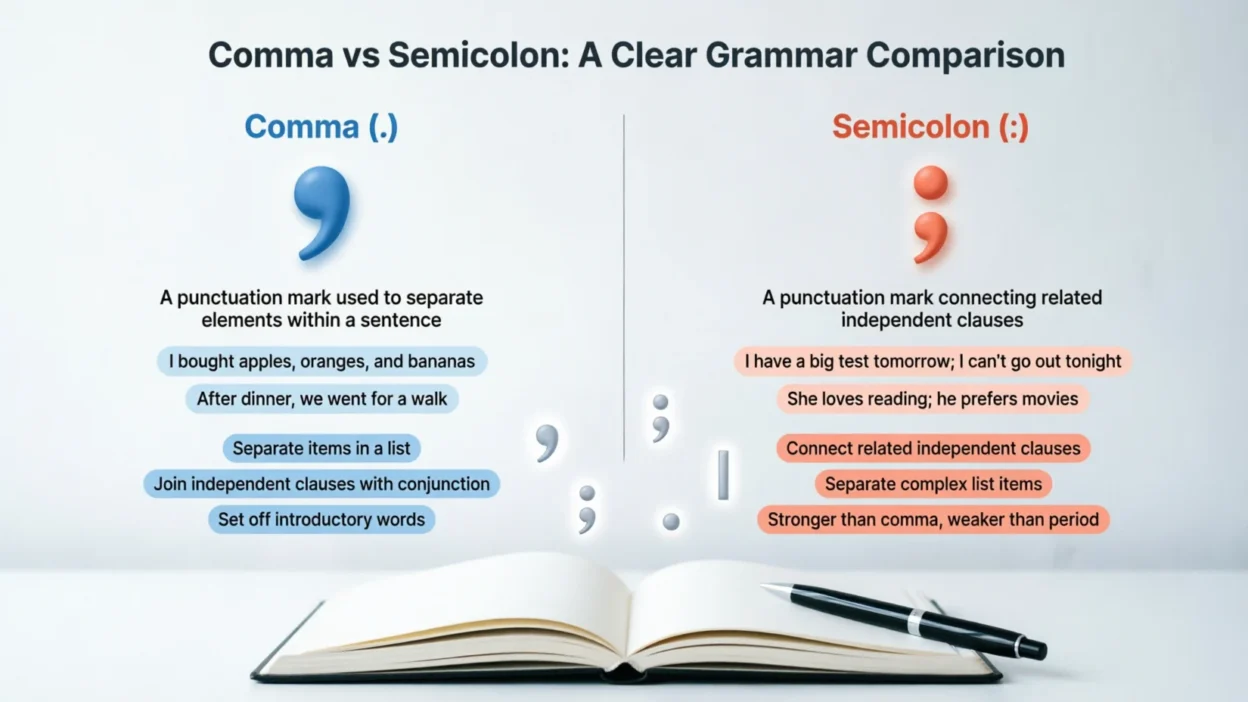
- Comma (,) separates words, phrases, clauses, or items in a list.
- Semicolon (;) connects two closely related independent clauses that could stand as complete sentences on their own.
Example with a comma:
- I bought apples, oranges, and bananas.
Example with a semicolon:
- I wanted to go for a walk; it started raining.
A semicolon creates a stronger connection than a period but a clearer separation than a comma.
What Is a Comma?
Definition of a Comma
A comma (,) is one of the most commonly used punctuation marks in English. It helps organize sentences, indicate pauses, and improve readability.
Without commas, writing can become confusing or difficult to understand.
Common Uses of Commas
Separating Items in a List
- We packed clothes, shoes, toiletries, and snacks.
After Introductory Words or Phrases
- After dinner, we watched a movie.
Separating Independent Clauses with a Coordinating Conjunction
- I wanted coffee, but the café was closed.
Adding Extra Information
- Sarah, my neighbor, loves gardening.
Why Commas Matter
Commas help readers understand your meaning quickly. A missing comma can sometimes change the entire meaning of a sentence.
Example:
- Let’s eat, Grandma.
- Let’s eat Grandma.
One comma makes a huge difference!
What Is a Semicolon?
Definition of a Semicolon
A semicolon (;) is used to connect closely related ideas. It sits somewhere between a comma and a period in strength.
Think of a semicolon as a bridge between two complete thoughts.
Common Uses of Semicolons
Joining Related Independent Clauses
- The meeting ended early; everyone went home.
Both parts could stand alone as complete sentences:
- The meeting ended early.
- Everyone went home.
Separating Complex List Items
When list items already contain commas, semicolons make things clearer.
Example:
- The conference included speakers from Paris, France; Rome, Italy; and Madrid, Spain.
Why Semicolons Matter
Semicolons improve sentence flow and show a close relationship between ideas without creating a run-on sentence.
Comma vs Semicolon: Key Differences
The easiest way to understand the difference is through comparison.
| Feature | Comma | Semicolon |
|---|---|---|
| Symbol | , | ; |
| Strength | Weaker pause | Stronger pause |
| Connects complete sentences alone | No | Yes |
| Used in lists | Yes | Sometimes |
| Used before coordinating conjunctions | Yes | Usually no |
| Creates a close relationship between ideas | Sometimes | Yes |
| Common in everyday writing | Very common | Less common |
When to Use a Comma
Before Coordinating Conjunctions
Use a comma before:
- And
- But
- Or
- Nor
- For
- So
- Yet
Examples:
- I studied hard, but I still felt nervous.
- She wanted pizza, and he preferred pasta.
With Introductory Elements
- In the morning, we went jogging.
- Fortunately, nobody was injured.
With Nonessential Information
- Mr. Johnson, our science teacher, won an award.
In Dates and Addresses
- July 4, 2025, was a Friday.
- Chicago, Illinois, is a major city.
When to Use a Semicolon
Between Two Independent Clauses
Use a semicolon when both sides can stand alone.
Examples:
- The project was challenging; the team completed it successfully.
- I enjoy reading; my sister prefers movies.
Before Transitional Words
Words such as:
- However
- Therefore
- Consequently
- Nevertheless
- Moreover
Examples:
- The weather forecast looked terrible; however, the event continued.
- She practiced daily; therefore, her performance improved.
In Complex Lists
- Our offices are located in Dallas, Texas; Atlanta, Georgia; and Seattle, Washington.
Common Mistakes People Make
Mistake 1: Using a Comma Instead of a Semicolon
This creates a comma splice.
Incorrect:
- The movie was excellent, everyone loved it.
Correct:
- The movie was excellent; everyone loved it.
Or:
- The movie was excellent, and everyone loved it.
Mistake 2: Using a Semicolon with an Incomplete Sentence
Incorrect:
- Because it was raining; we stayed indoors.
Correct:
- Because it was raining, we stayed indoors.
Mistake 3: Overusing Semicolons
Semicolons can make writing feel overly formal if used too often.
Balance them with periods and commas for smoother readability.
Mistake 4: Forgetting the Comma After Transitional Phrases
Incorrect:
- However we decided to continue.
Correct:
- However, we decided to continue.
Examples of Comma vs Semicolon in Action
Example 1
Comma:
- I wanted to leave early, but the meeting ran late.
Semicolon:
- I wanted to leave early; the meeting ran late.
Example 2
Comma:
- She loves painting, reading, and photography.
Semicolon:
- She loves painting; her brother enjoys music.
Example 3
Comma:
- After lunch, we returned to work.
Semicolon:
- The lunch break ended; productivity increased immediately.
Helpful Trick to Remember the Difference
A simple memory trick:
Comma = Small Pause
Think of a comma as taking a quick breath while speaking.
Semicolon = Strong Connection
Think of a semicolon as linking two complete thoughts that belong together.
If both parts can stand alone as sentences, a semicolon may work.
If not, you probably need a comma.
American vs British English Differences
When it comes to comma vs semicolon, American and British English follow essentially the same rules.
There are some punctuation differences between American and British writing, especially regarding quotation marks, but the use of commas and semicolons remains largely identical.
For example:
American English:
- She said, “I’ll call later.”
British English:
- She said, ‘I’ll call later’.
However, comma and semicolon rules stay consistent across both varieties of English.
Why Proper Punctuation Improves Writing
Good punctuation does more than satisfy grammar rules.
It helps readers:
- Understand ideas faster
- Avoid confusion
- Follow sentence structure
- Enjoy smoother reading experiences
Whether you’re writing emails, essays, blog posts, business reports, or social media content, mastering punctuation can instantly improve your communication skills.
FAQs About Comma vs Semicolon
What is the main difference between a comma and a semicolon?
A comma separates parts of a sentence, while a semicolon connects two related complete sentences.
Can a semicolon replace a comma?
Sometimes, but only when joining two independent clauses. In many situations, a comma remains the correct choice.
Is a semicolon stronger than a comma?
Yes. A semicolon creates a stronger separation than a comma but a weaker separation than a period.
Can I use a semicolon before “however”?
Yes. A semicolon is commonly used before transitional words like however, therefore, and nevertheless.
What is a comma splice?
A comma splice occurs when two complete sentences are incorrectly joined with only a comma.
Are semicolons outdated?
No. Although they’re less common than commas, semicolons remain an important punctuation tool in modern writing.
Should I use semicolons in professional writing?
Absolutely. Semicolons can make professional writing more sophisticated and precise when used correctly.
How can I tell if I need a semicolon?
Check whether both sides of the punctuation can stand alone as complete sentences. If they can, a semicolon may be appropriate.
Summary
Understanding comma vs semicolon doesn’t have to be complicated. A comma helps organize information within a sentence, separate list items, and connect clauses with conjunctions. A semicolon, on the other hand, joins two closely related independent clauses and creates a stronger connection between ideas.
The key is to focus on sentence structure. If you’re connecting complete thoughts without using a coordinating conjunction, a semicolon is often the right choice. If you’re separating items, adding introductory phrases, or connecting clauses with words like and or but, a comma is usually what you need.
Actionable Takeaway
The next time you’re unsure whether to use a comma or a semicolon, ask yourself one simple question:
Can both sides stand alone as complete sentences?
- If yes, consider a semicolon.
- If no, a comma is probably the better choice.
Practice with your everyday writing, and you’ll quickly develop an instinct for choosing the correct punctuation mark.

Fenwick Quentin is a creative blogging author known for his analytical yet engaging writing style.
He explores topics such as innovation, digital culture, and personal development with depth and clarity.
Through his articles, Fenwick encourages readers to think critically and embrace continuous growth.