Have you ever typed ladder when you meant latter or paused to wonder which one belongs in a sentence? You’re not alone. These two words look remarkably similar, differ by only one letter, and can easily confuse writers, students, and English learners.
The good news is that understanding ladder vs latter is surprisingly simple once you know their meanings. One refers to a physical object used for climbing, while the other helps compare two choices. In this guide, you’ll learn the difference, see practical examples, avoid common mistakes, and gain confidence in using both words correctly.
Quick Answer
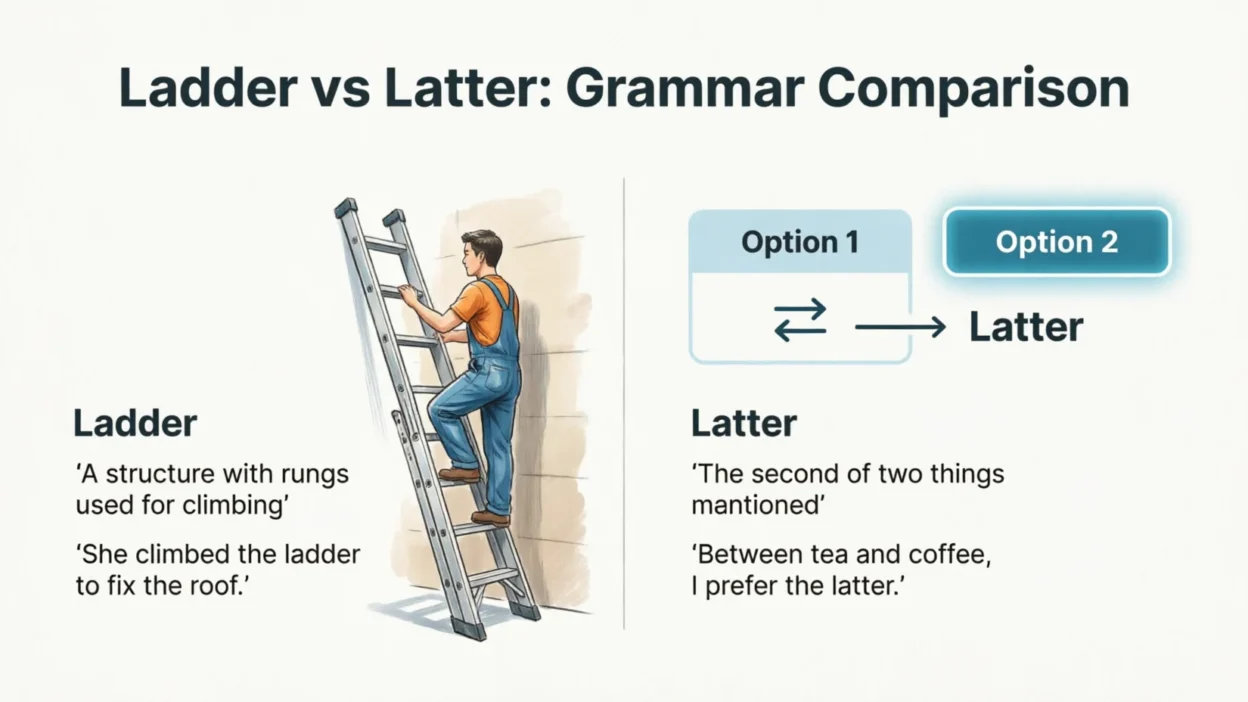
- Ladder is a noun that refers to a structure with steps or rungs used for climbing.
- Latter refers to the second of two people, things, or options previously mentioned.
Examples:
- He climbed the ladder to clean the roof. ✅
- I was offered tea and coffee; I chose the latter. ✅
A simple way to remember it:
👉 Ladder = climbing tool
👉 Latter = second option
What Does “Ladder” Mean?
Definition of Ladder
A ladder is a piece of equipment designed for climbing up or down. It typically consists of two side supports connected by rungs or steps.
Ladders are commonly used in homes, workplaces, construction sites, and many other settings.
Examples of Ladder in Sentences
- She used a ladder to reach the top shelf.
- The firefighter climbed the ladder to rescue the cat.
- We bought a new ladder for painting the house.
- The gardener leaned the ladder against the tree.
In each example, ladder refers to a physical object.
Common Types of Ladders
- Step ladder
- Extension ladder
- Rope ladder
- Folding ladder
- Platform ladder
The word can also be used figuratively.
Ladder in Figurative Expressions
You may hear phrases like:
- Career ladder
- Corporate ladder
- Social ladder
Examples:
- She worked hard to climb the corporate ladder.
- He quickly moved up the career ladder.
Here, ladder symbolizes progress or advancement.
What Does “Latter” Mean?
Definition of Latter
Latter refers to the second item, person, or option when two things have been mentioned.
It helps avoid repetition and makes writing smoother.
Examples of Latter in Sentences
- Between reading and watching movies, I prefer the latter.
- The meeting could be on Thursday or Friday; the latter works best for me.
- Sarah and Emily volunteered, but the latter arrived first.
In each sentence, latter refers to the second option mentioned.
Opposite of Latter
The opposite of latter is former.
Example:
- Of tea and coffee, the former is healthier for me, but the latter tastes better.
Here:
- Former = tea
- Latter = coffee
Ladder vs Latter: Key Differences
The easiest way to understand these words is through direct comparison.
| Feature | Ladder | Latter |
|---|---|---|
| Part of Speech | Noun | Adjective/Pronoun |
| Meaning | A climbing structure | The second of two items |
| Physical Object | Yes | No |
| Used in Comparisons | No | Yes |
| Common Phrase | Career ladder | Former and latter |
| Example | The ladder broke. | I chose the latter. |
The meanings are completely different despite their similar spellings.
Why People Confuse Ladder and Latter
Similar Spelling
The words differ by only one letter:
- Ladder
- Latter
This similarity often leads to typing errors.
Similar Pronunciation
Depending on accent and speaking speed, the words can sound somewhat alike, especially for English learners.
Auto-Correct and Typing Mistakes
Because both words are valid English words, spell checkers may not catch the mistake if the wrong word is used in context.
For example:
- I chose the ladder option.
The sentence is grammatically correct but semantically incorrect.
When to Use Ladder
Talking About Climbing Equipment
Use ladder whenever you’re referring to something used to climb.
Examples:
- The worker carried a ladder.
- The ladder reached the second floor.
Talking About Progress
Use ladder in figurative expressions related to advancement.
Examples:
- She climbed the corporate ladder.
- They moved up the social ladder.
Talking About Ranking Systems
Examples:
- The team climbed the league ladder.
- He advanced up the organizational ladder.
When to Use Latter
Referring to the Second of Two Things
Use latter when comparing two choices.
Examples:
- I considered renting or buying; the latter seemed wiser.
- You can travel by train or plane; the latter is faster.
Avoiding Repetition
Instead of repeating the second item, use latter.
Example:
- My options were marketing and design. The latter interested me more.
Academic and Professional Writing
Latter appears frequently in essays, reports, and professional communication because it improves clarity and conciseness.
Common Mistakes to Avoid
Mistake 1: Using Ladder Instead of Latter
Incorrect:
- Between pizza and pasta, I prefer the ladder.
Correct:
- Between pizza and pasta, I prefer the latter.
The sentence involves choosing between two options, so latter is correct.
Mistake 2: Using Latter for Physical Objects
Incorrect:
- The worker climbed the latter.
Correct:
- The worker climbed the ladder.
A climbing structure requires ladder.
Mistake 3: Forgetting the Former-Latter Pair
When discussing two items, many writers use latter but forget former.
Example:
- Of the two proposals, the former was cheaper and the latter was more innovative.
Using both terms creates balance and clarity.
Easy Memory Tricks
Ladder Has Rungs
Think of the double “dd” in ladder as the rungs you climb.
Visualizing a real ladder can help you remember the meaning instantly.
Latter Means Last Mentioned
Notice that latter begins with “lat”, which can remind you of late or later.
The latter item comes later in the sentence.
Quick Reminder
- Ladder = climb
- Latter = second choice
This simple association works every time.
American vs British English Differences
There is virtually no difference between American and British English regarding ladder vs latter.
American English
- He climbed the ladder.
- I preferred the latter option.
British English
- He climbed the ladder.
- I preferred the latter option.
Both spellings and meanings remain identical across these major varieties of English.
Related Words and LSI Keywords
When researching ladder vs latter, you may also encounter:
- Former vs latter
- Commonly confused words
- English vocabulary
- Homophone-like words
- Grammar mistakes
- Word usage
- English writing tips
- Vocabulary comparison
- Similar-looking words
- Language learning
Understanding these related concepts helps strengthen your overall English skills.
FAQs About Ladder vs Latter
What is the difference between ladder and latter?
A ladder is a climbing structure, while latter refers to the second of two options previously mentioned.
Is ladder a noun?
Yes. Ladder is a noun that refers to a physical object used for climbing.
Is latter a noun?
Not usually. Latter commonly functions as an adjective or pronoun referring to the second of two items.
Can ladder be used figuratively?
Yes. Expressions such as career ladder and corporate ladder use the word figuratively.
What does latter mean in simple terms?
It means the second of two things that were just mentioned.
What is the opposite of latter?
The opposite is former, which refers to the first of two items.
Are ladder and latter homophones?
No. They are not true homophones, although some speakers may pronounce them similarly.
How can I remember the difference?
Think: ladder = climb, latter = second choice.
Final Summary
Understanding ladder vs latter becomes easy once you focus on their meanings. A ladder is something you climb, whether it’s a physical ladder, a career ladder, or a social ladder. The word always relates to advancement, height, or progression.
Latter, on the other hand, refers to the second of two people, things, or choices previously mentioned. It often appears alongside former and is especially useful in clear, concise writing. Although these words look similar, they serve completely different purposes in English.
Actionable Takeaway
The next time you encounter these words, use this quick test:
- If you’re talking about climbing, steps, or advancement, choose ladder.
- If you’re referring to the second of two options, choose latter.
Remember this simple phrase:
Ladder = climb. Latter = second.
Mastering this distinction will help you write with greater confidence and avoid a very common English mistake.

Fenwick Quentin is a creative blogging author known for his analytical yet engaging writing style.
He explores topics such as innovation, digital culture, and personal development with depth and clarity.
Through his articles, Fenwick encourages readers to think critically and embrace continuous growth.