Have you ever wondered whether you should write continually or continuously? You’re not alone. These two words are often used interchangeably because they both relate to something happening over time. However, they have slightly different meanings, and using the right one can make your writing clearer and more precise.
Understanding the difference between continually vs continuously is especially helpful for students, professionals, writers, and English learners. While many people won’t notice the distinction in casual conversation, choosing the correct word can improve your communication and help you express exactly what you mean. Let’s break it down in a simple and memorable way.
Quick Answer
- Continually means something happens repeatedly with interruptions.
- Continuously means something happens without stopping or interruption.
Examples:
- The phone rang continually throughout the afternoon. ✅ (It rang again and again.)
- The river flowed continuously for miles. ✅ (It never stopped flowing.)
A simple memory trick:
👉 Continually = repeated occurrences
👉 Continuously = nonstop action
What Does “Continually” Mean?
Definition of Continually
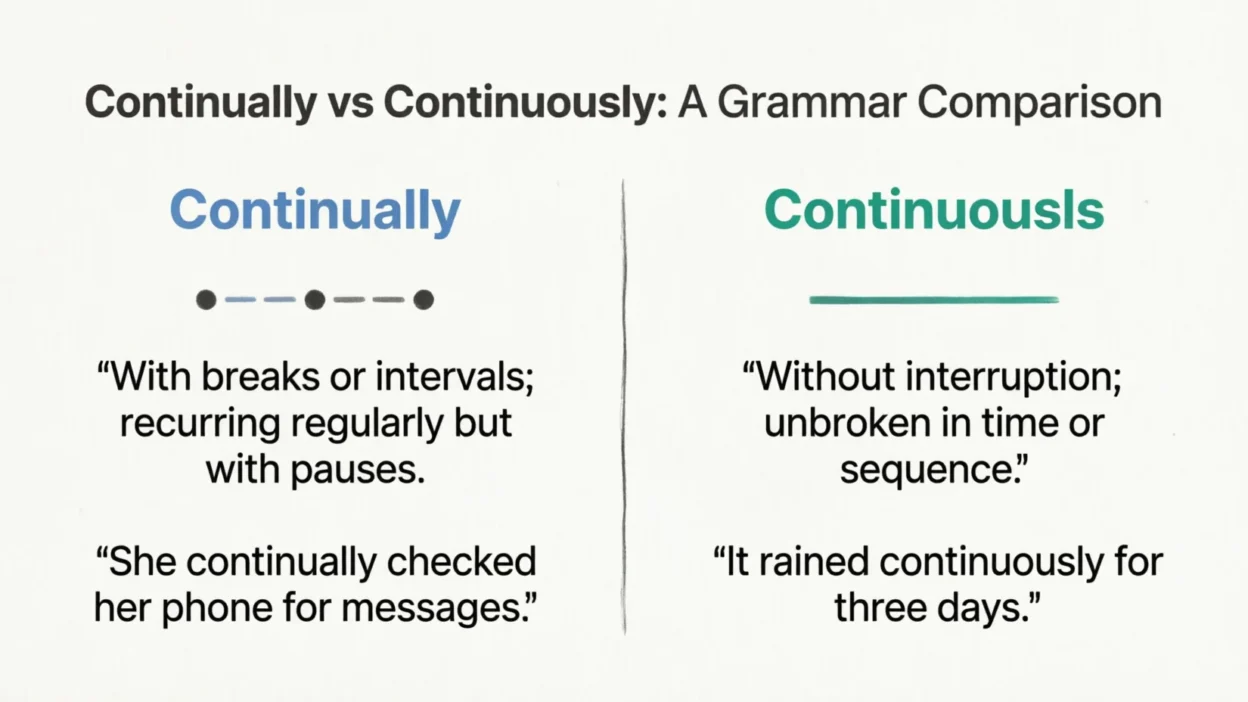
Continually means something occurs repeatedly over a period of time, but not necessarily without interruption.
In other words, the action happens again and again, often with pauses between occurrences.
Examples of Continually
- She continually checks her email during the workday.
- The baby continually woke up throughout the night.
- He was continually asking questions during the meeting.
- The company continually updates its policies.
In these examples, the action repeats many times but doesn’t happen every single second.
Common Uses of Continually
You’ll often use continually when describing:
- Repeated behaviors
- Frequent interruptions
- Ongoing habits
- Regular occurrences
- Recurring actions
Synonyms for Continually
- Repeatedly
- Frequently
- Regularly
- Often
- Again and again
- Persistently
What Does “Continuously” Mean?
Definition of Continuously
Continuously means something happens without stopping, breaking, or pausing.
The action remains constant from beginning to end.
Examples of Continuously
- The machine operated continuously for 24 hours.
- Rain fell continuously throughout the storm.
- The heart beats continuously throughout life.
- The internet connection remained continuously active.
Unlike continually, there are no meaningful interruptions.
Common Uses of Continuously
The word often appears when discussing:
- Machines
- Technology
- Natural processes
- Manufacturing systems
- Scientific observations
Synonyms for Continuously
- Constantly
- Unceasingly
- Nonstop
- Persistently
- Without interruption
- Steadily
Continually vs Continuously: Key Differences
Although the words are closely related, their distinction becomes clear when you compare them side by side.
| Feature | Continually | Continuously |
|---|---|---|
| Meaning | Repeatedly over time | Without interruption |
| Includes Pauses | Yes | No |
| Focus | Recurring events | Constant action |
| Common Contexts | Habits, behaviors, interruptions | Machines, processes, flow |
| Example | The dog barked continually. | The fan ran continuously. |
The most important difference is whether interruptions exist.
Why People Confuse Continually and Continuously
Similar Meanings
Both words come from the root word continue, which naturally makes them seem interchangeable.
Similar Appearance
The spellings are nearly identical, differing by only a few letters.
Everyday Usage
In casual conversation, many speakers use the terms loosely without worrying about the distinction.
For example:
- The phone was ringing continuously.
- The phone was ringing continually.
Most listeners understand both sentences, even though continually may be more accurate if the ringing stopped between calls.
When to Use Continually
Repeated Actions
Use continually when something happens over and over again.
Examples:
- The child continually interrupted the conversation.
- Customers continually requested additional features.
Frequent Occurrences
Examples:
- Traffic continually slows during rush hour.
- She continually visits her grandparents.
Recurring Problems
Examples:
- The software continually crashes after updates.
- The company continually faces staffing challenges.
In these cases, the action repeats but isn’t truly nonstop.
When to Use Continuously
Uninterrupted Processes
Use continuously when something never stops.
Examples:
- The conveyor belt moved continuously.
- The waterfall flowed continuously.
Constant Operation
Examples:
- The server runs continuously to support users.
- The security cameras record continuously.
Natural Phenomena
Examples:
- The sun continuously emits energy.
- The Earth’s atmosphere continuously circulates air.
These actions occur without meaningful breaks.
Real-Life Examples of Continually vs Continuously
Example 1: Phone Calls
Continually:
- The office phone rang continually all morning.
The phone rang many times but stopped between calls.
Continuously:
- The phone rang continuously for ten minutes.
The ringing never stopped during those ten minutes.
Example 2: Rain
Continually:
- It rained continually throughout the week.
Rain came and went repeatedly.
Continuously:
- It rained continuously for six hours.
Rain never stopped during that period.
Example 3: Employee Behavior
Continually:
- The employee continually missed deadlines.
The behavior repeated.
Continuously:
This usage would sound unnatural because missing deadlines isn’t a nonstop action.
Common Mistakes to Avoid
Mistake 1: Using Continuously for Repeated Actions
Incorrect:
- She continuously checked her phone during dinner.
Better:
- She continually checked her phone during dinner.
Checking a phone happens repeatedly, not nonstop.
Mistake 2: Using Continually for Constant Processes
Incorrect:
- The engine ran continually for 12 hours.
Better:
- The engine ran continuously for 12 hours.
The engine operated without stopping.
Mistake 3: Assuming They Always Mean the Same Thing
While many people use them interchangeably, careful writing benefits from choosing the more precise word.
Easy Memory Tricks
Continually = Repeatedly
Notice that continually often involves repeated events.
Think:
- Continually = Again and again
Continuously = Constantly
The word continuously contains the idea of an uninterrupted flow.
Think:
- Continuously = Never stops
Quick Test
Ask yourself:
Did the action pause at any point?
- Yes → Continually
- No → Continuously
American vs British English Differences
There is very little difference between American and British English regarding continually vs continuously.
Both varieties generally follow the same distinction:
- Continually = repeated with interruptions
- Continuously = uninterrupted
American English
- The employee continually arrived late.
- The machine operated continuously.
British English
- The employee continually arrived late.
- The machine operated continuously.
Although some speakers blur the distinction in everyday speech, formal writing in both regions typically follows these definitions.
Why Using the Right Word Matters
Choosing the correct word improves:
- Clarity
- Precision
- Professionalism
- Academic writing quality
- Reader understanding
For example:
- The machine runs continuously tells readers there are no interruptions.
- The machine runs continually suggests occasional pauses.
That small difference can completely change the meaning.
FAQs About Continually vs Continuously
What is the main difference between continually and continuously?
Continually means repeatedly with interruptions, while continuously means without interruption.
Can continually and continuously be used interchangeably?
In casual conversation, sometimes. In formal writing, it’s better to follow the distinction.
Which word means nonstop?
Continuously means nonstop.
Which word means again and again?
Continually means repeatedly or again and again.
Is continuously more formal than continually?
Not necessarily. Both are standard English words used in formal and informal contexts.
Can rain fall continually?
Yes. If it rains on and off throughout a period, continually is appropriate.
Can a machine operate continually?
It can, but continuously is usually more precise if it never stops.
Do British and American English use these words differently?
No. Both generally follow the same meanings and usage guidelines.
Final Summary
Understanding continually vs continuously comes down to one simple distinction: interruptions. If an action happens repeatedly over time with pauses in between, continually is the better choice. If the action never stops and flows without interruption, continuously is the correct word.
Although many people use these words interchangeably, choosing the right one makes your writing more precise and professional. Whether you’re writing emails, reports, essays, or blog posts, knowing the difference helps communicate your ideas more clearly.
Actionable Takeaway
Whenever you’re unsure, ask yourself this question:
Did the action stop at any point?
- If yes, use continually.
- If no, use continuously.
Remember this simple phrase:
Continually = repeated. Continuously = nonstop.
Master this distinction, and you’ll avoid one of the most common word-choice mistakes in English.

Fenwick Quentin is a creative blogging author known for his analytical yet engaging writing style.
He explores topics such as innovation, digital culture, and personal development with depth and clarity.
Through his articles, Fenwick encourages readers to think critically and embrace continuous growth.