The debate over hung vs hanged confuses many English learners and native speakers alike. At first glance, both words seem interchangeable because they are past-tense forms of the verb hang. However, English has a unique rule that separates these two words based on context.
If you’ve ever wondered whether a picture was hung on a wall or hanged on a wall, you’re asking the right question. Understanding the distinction can make your writing more accurate and professional. In this guide, you’ll learn the meaning of each word, see real-world examples, discover common mistakes, and master the correct usage once and for all.
Quick Answer
- Hung is the standard past tense and past participle of hang for most situations.
- Hanged is used specifically when referring to execution by hanging.
Examples:
- She hung the painting above the fireplace. ✅
- The criminal was hanged for his crimes. ✅
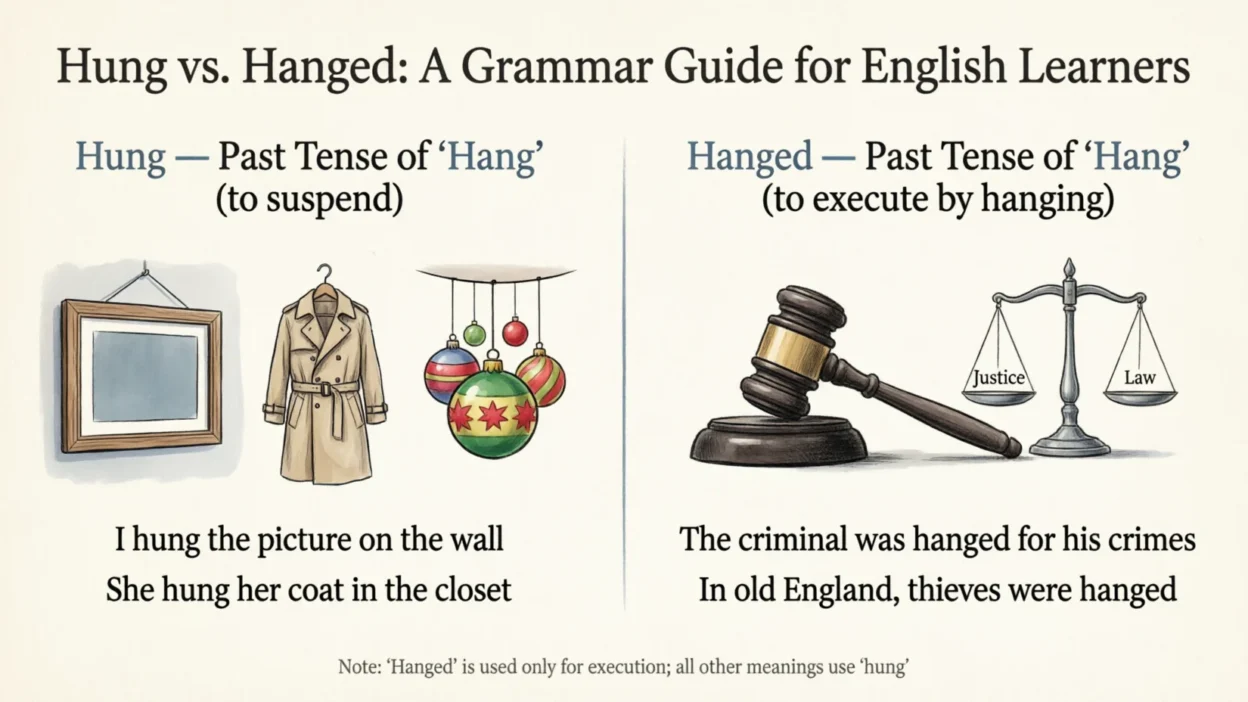
A simple way to remember it: use hung for objects and everyday actions, and use hanged for judicial executions.
What Does “Hung” Mean?
Definition of Hung
Hung is the most common past tense and past participle form of the verb hang. It refers to placing, suspending, or attaching something from above.
This is the form you’ll use in nearly all everyday situations.
Examples of Hung
- We hung holiday decorations around the house.
- She hung her coat by the door.
- The artist hung his paintings in the gallery.
- They hung a banner across the street.
In each example, something is physically suspended or attached.
Common Situations Where Hung Is Used
- Hanging pictures
- Hanging clothes
- Hanging decorations
- Hanging signs
- Hanging lights
Because these uses are so common, hung appears much more frequently in modern English than hanged.
What Does “Hanged” Mean?
Definition of Hanged
Hanged is a special form of hang used almost exclusively when referring to execution by hanging.
Historically, hanging was a method of capital punishment, and English preserved a separate past tense form for this specific meaning.
Examples of Hanged
- The prisoner was hanged in the town square.
- Several individuals were hanged during that period of history.
- According to historical records, he was hanged for treason.
In these examples, hanged refers specifically to a person being executed.
Why Does English Have This Exception?
English contains many historical irregularities. Over time, most uses of hang adopted hung, but legal and historical contexts retained hanged to clearly distinguish executions from ordinary hanging.
Hung vs Hanged: Key Differences
The easiest way to understand the distinction is through comparison.
| Feature | Hung | Hanged |
|---|---|---|
| Meaning | Suspended or attached | Executed by hanging |
| Common Usage | Very common | Limited and specific |
| Refers to Objects | Yes | No |
| Refers to Decorations | Yes | No |
| Refers to Judicial Execution | No | Yes |
| Example | The picture was hung. | The prisoner was hanged. |
The rule is straightforward: if you’re talking about anything other than execution, use hung.
Why People Confuse Hung and Hanged
Both Come From the Same Verb
Since both words originate from hang, many people assume they are interchangeable.
However, modern English treats them differently.
Rare Exposure to Hanged
Most people encounter hung regularly but rarely see hanged outside history books, legal discussions, or historical fiction.
This limited exposure contributes to confusion.
Influence of Everyday Speech
In casual conversation, some speakers use hung for every situation, even when discussing historical executions. While many listeners understand the meaning, formal writing should follow the traditional distinction.
Common Examples of Hung
Around the Home
- She hung family photos in the hallway.
- The curtains were hung yesterday.
At Work
- The certificate was hung in the office lobby.
- The company banner was hung above the entrance.
During Holidays
- We hung Christmas lights on the roof.
- The children hung decorations on the tree.
These examples represent the vast majority of situations where you’ll use the verb hang.
Common Examples of Hanged
Historical Writing
- The accused man was hanged after the trial.
- Several rebels were hanged during the uprising.
Legal and Historical Contexts
- The records indicate that the prisoner was hanged in 1820.
- He was convicted and later hanged.
Notice that every example involves execution.
Common Mistakes to Avoid
Mistake 1: Using Hanged for Objects
Incorrect:
- The painting was hanged on the wall.
Correct:
- The painting was hung on the wall.
Objects are always hung, not hanged.
Mistake 2: Using Hung for Executions
Incorrect:
- The criminal was hung for his crimes.
Correct:
- The criminal was hanged for his crimes.
In formal writing, executions require hanged.
Mistake 3: Assuming One Form Is Always Correct
Some writers try to simplify things by using only hung. While this often works in conversation, it isn’t technically correct in historical or legal contexts involving execution.
Memory Trick for Hung vs Hanged
A simple trick can help you remember the difference.
Think About the Subject
If the sentence involves:
- A picture → hung
- A coat → hung
- Decorations → hung
- A person executed by law → hanged
Another easy reminder:
Things are hung. People executed by hanging are hanged.
This rule works almost every time.
American vs British English Differences
Unlike many grammar topics, there is very little difference between American and British English when it comes to hung vs hanged.
Both varieties generally follow the same rule:
- Hung for ordinary uses
- Hanged for executions
American English
- The painting was hung perfectly.
- The outlaw was hanged.
British English
- The portrait was hung above the fireplace.
- The prisoner was hanged.
Writers on both sides of the Atlantic typically follow this distinction.
Historical Evolution of the Words
Origins of Hang
The verb hang comes from Old English and has existed for centuries.
Historically, both hung and hanged appeared in various contexts.
Standardization Over Time
As English evolved, hung became the preferred form for nearly all uses.
However, legal and historical traditions preserved hanged specifically for executions.
This distinction remains the accepted standard today.
Related Grammar Terms and LSI Keywords
When researching hung vs hanged, you may also encounter:
- Past tense of hang
- Past participle of hang
- English grammar rules
- Irregular verbs
- Common grammar mistakes
- Word usage
- Confusing English words
- Grammar comparison
- Writing accuracy
- Proper English usage
Understanding these related concepts can strengthen your overall grammar skills.
FAQs About Hung vs Hanged
Is hanged grammatically correct?
Yes. It is correct when referring to execution by hanging.
Can I say a picture was hanged?
No. A picture should be described as hung, not hanged.
Why does English use two past tenses for hang?
Historical usage preserved hanged for executions while hung became standard for all other meanings.
Which word is more common?
Hung is far more common because it applies to everyday situations.
Is “the criminal was hung” wrong?
In formal grammar, yes. The correct form is the criminal was hanged.
Do American and British English use the same rule?
Yes. Both generally use hung for objects and hanged for executions.
Is hanged only used for people?
Almost always. It specifically refers to execution by hanging.
What is the easiest way to remember the difference?
Remember: objects are hung; executed people are hanged.
Final Summary
The distinction between hung vs hanged is one of English grammar’s most famous exceptions. While both words come from the verb hang, they serve different purposes. Hung is the standard form used for pictures, clothes, decorations, signs, and nearly every everyday situation involving something being suspended.
Hanged, on the other hand, has a very specific role. It refers exclusively to execution by hanging and is mainly found in historical, legal, and formal writing. Understanding this simple distinction helps improve clarity, accuracy, and confidence in your writing.
Actionable Takeaway
Whenever you’re unsure which word to choose, ask yourself one question:
Are you talking about an object or an execution?
- If it’s an object, decoration, sign, coat, picture, or anything similar, use hung.
- If it’s a judicial execution by hanging, use hanged.
Following this simple rule will help you avoid one of the most common grammar mistakes in English.

Fenwick Quentin is a creative blogging author known for his analytical yet engaging writing style.
He explores topics such as innovation, digital culture, and personal development with depth and clarity.
Through his articles, Fenwick encourages readers to think critically and embrace continuous growth.