The confusion between foreword vs forward is incredibly common because these two words sound exactly alike in spoken English. However, despite their identical pronunciation, they have completely different meanings, spellings, and uses. Mixing them up can create grammar mistakes that affect clarity and professionalism in your writing.
If you have ever wondered whether a book contains a “foreword” or a “forward,” you are not alone. Writers, students, bloggers, and professionals frequently confuse these homophones. Fortunately, the difference is actually simple once you understand how each word functions in context.
In this complete guide, you will learn the meanings of foreword and forward, grammar rules, sentence examples, common mistakes, comparison tables, practical usage tips, and easy memory tricks to help you use these words correctly every time.
Quick Answer
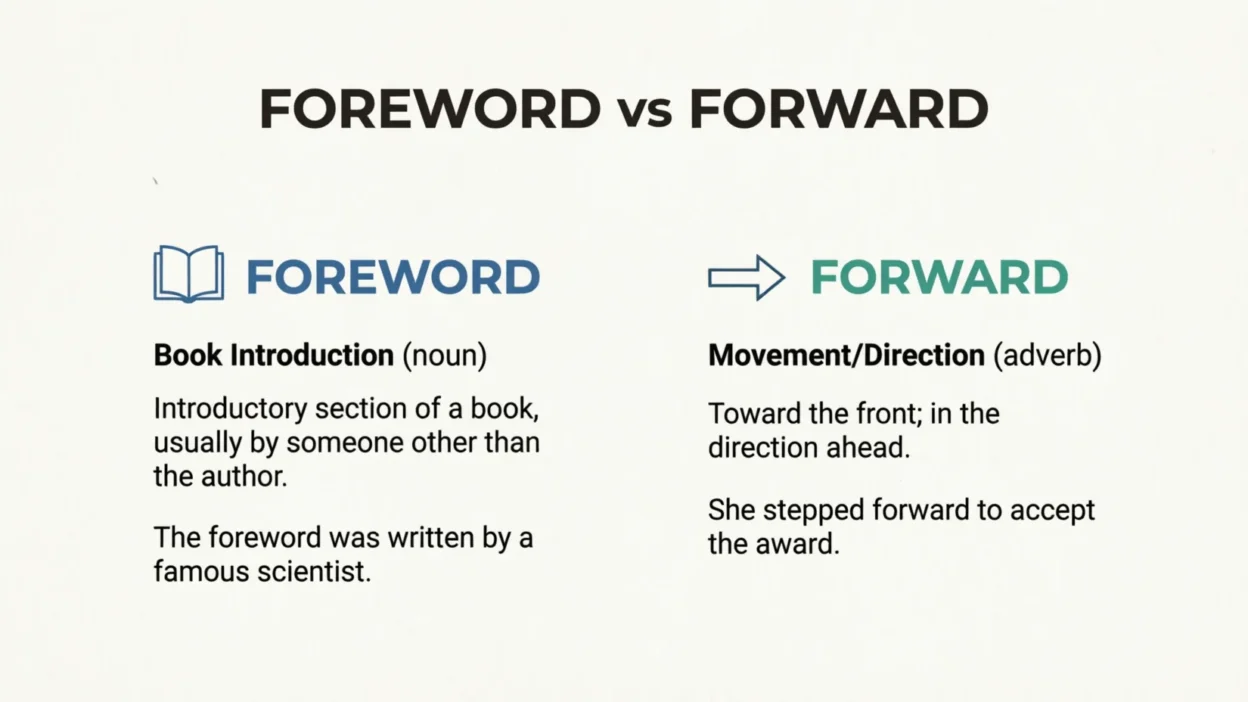
- Foreword is a noun referring to an introductory section at the beginning of a book.
- Forward usually means ahead, onward, or toward the front.
- The author wrote a thoughtful foreword for the novel. ✅
- Please move forward with the project. ✅
Simple rule:
- Foreword = book introduction
- Forward = direction or progress
What Does “Foreword” Mean?
A foreword is:
- an introduction at the beginning of a book
- usually written by someone other than the author
- intended to provide context, praise, or background
It commonly appears in:
- nonfiction books
- autobiographies
- academic works
- business books
- memoirs
Examples of Foreword
- The professor wrote the foreword for the textbook.
- I enjoyed reading the foreword before starting the novel.
- Her latest book includes a foreword by a famous historian.
- The foreword explains why the book is important.
What Does “Forward” Mean?
“Forward” is usually used as:
- an adjective
- adverb
- verb
- noun
It generally relates to:
- movement ahead
- progress
- advancement
- sending something onward
Examples of Forward
- The team moved forward confidently.
- Please forward the email to management.
- She took a step forward.
- We are looking forward to the event.
Foreword vs Forward Comparison Table
| Word | Part of Speech | Meaning | Common Context | Example |
|---|---|---|---|---|
| Foreword | Noun | Introductory section in a book | Publishing/writing | The foreword was inspiring |
| Forward | Verb/adjective/adverb/noun | Ahead or onward | Movement/progress | Move forward carefully |
The Main Difference Between Foreword and Forward
The easiest way to remember the difference is this:
Foreword = Words Before a Book
Think:
- “fore” = before
- “word” = writing
Together:
- words before the main text
Forward = Ahead or Onward
Think:
- movement
- progress
- direction
Example:
- We moved forward with the plan.
How to Use “Foreword” Correctly
Use “foreword” only when discussing the introductory section of a book.
Common Uses of Foreword
- book foreword
- write a foreword
- read the foreword
- foreword by a famous author
- introductory foreword
Correct Examples
- The memoir contains a moving foreword.
- She asked her mentor to write the foreword.
- I skipped the foreword and started chapter one.
- The foreword provides historical context.
How to Use “Forward” Correctly
Use “forward” when discussing:
- movement
- progress
- advancement
- sending information onward
Common Uses of Forward
- move forward
- look forward to
- forward an email
- step forward
- thinking forward
Correct Examples
- Please forward this message.
- The company plans to move forward quickly.
- She stepped forward confidently.
- We look forward to hearing from you.
Common Mistakes With Foreword vs Forward
Because these words sound identical, many writers accidentally choose the wrong spelling.
Mistake 1: Using Forward for Book Introductions
Incorrect:
- The author wrote a forward for the novel. ❌
Correct:
- The author wrote a foreword for the novel. ✅
Why?
A book introduction is called a:
- foreword
Mistake 2: Using Foreword for Direction
Incorrect:
- We should move foreword carefully. ❌
Correct:
- We should move forward carefully. ✅
Why?
The sentence refers to movement and progress.
Mistake 3: Confusing Pronunciation With Spelling
Since both words sound exactly alike, writers often rely on sound instead of meaning.
Practical Example Paragraphs
Example Using Foreword
The biography begins with a heartfelt foreword written by the author’s longtime friend. It offers readers insight into the inspiration behind the book and the challenges faced during its creation.
Example Using Forward
After months of planning, the team finally moved forward with the product launch. Everyone felt excited about the company’s future direction.
Placement and Grammar Rules Table
| Phrase | Sentence Placement | Tone/Formality | Example Sentence |
|---|---|---|---|
| Write a foreword | Middle/end | Formal/literary | She agreed to write a foreword |
| Read the foreword | Middle | Neutral | I read the foreword first |
| Move forward | Middle/end | Professional/general | We must move forward together |
| Forward the email | Beginning/middle | Professional | Please forward the document |
American vs British English Differences
There are no major spelling differences between American and British English for:
- foreword
- forward
Both language varieties use the same spellings and meanings.
In Both Variations
Correct:
- The foreword was informative.
- We are moving forward confidently.
Easy Memory Tricks for Foreword vs Forward
Trick 1: Foreword Contains “Word”
The word:
- foreword
contains:
- word
which helps you remember it relates to:
- writing
- books
- text
Trick 2: Forward Means Movement
Think of:
- moving forward
- going ahead
This helps separate it from publishing terminology.
Why Correct Usage Matters
Using the correct word improves:
- professionalism
- grammar accuracy
- writing clarity
- reader trust
Mistakes can:
- confuse readers
- weaken credibility
- create awkward phrasing
This matters especially in:
- academic writing
- publishing
- business communication
- professional emails
- educational content
Similar English Word Confusions
People searching for “foreword vs forward” often also confuse:
- stationery vs stationary
- complement vs compliment
- affect vs effect
- discreet vs discrete
- principal vs principle
These commonly confused words often sound alike but have different meanings and functions.
Everyday Examples of Foreword and Forward
Correct Uses of Foreword
- The foreword explains the author’s motivation.
- A celebrity wrote the foreword for the cookbook.
- I enjoyed the foreword more than expected.
- The foreword appears before chapter one.
Correct Uses of Forward
- Please forward the invitation.
- The players moved forward aggressively.
- We are looking forward to the weekend.
- The company continues moving forward.
Incorrect Examples
- She wrote a forward for the book. ❌
- We moved foreword with confidence. ❌
FAQs About Foreword vs Forward
What is the difference between foreword and forward?
“Foreword” is a book introduction, while “forward” relates to movement, progress, or direction.
Is foreword one word?
Yes. “Foreword” is always written as one word.
Why is it called a foreword?
Because it contains words placed before the main text of a book.
Can forward be a verb?
Yes. Example:
- Please forward the email.
Is foreword only used in books?
Mostly, yes. It is a publishing term used for introductions.
How do you remember foreword vs forward?
Remember:
- foreword contains “word”
- forward refers to moving ahead
Are foreword and forward pronounced differently?
No. They are pronounced the same way.
Final Thoughts
Understanding the difference between foreword vs forward can help improve your grammar, writing clarity, and professional communication. Although the words sound identical, their meanings are completely different. “Foreword” refers to an introductory section in a book, while “forward” relates to movement, progress, or advancement.
Mastering commonly confused words like these makes your writing more polished and trustworthy. Whether you are writing emails, articles, essays, or publishing content, using the correct word helps readers understand your message clearly.
Actionable Takeaway
Use this quick rule:
- foreword = book introduction
- forward = ahead or onward
Easy memory trick:
- “foreword” contains the word “word,” which connects it to writing and books
Before choosing the spelling, ask yourself:
- “Am I talking about a book introduction or movement ahead?”
That simple question will help you select the correct word every time.

Fenwick Quentin is a creative blogging author known for his analytical yet engaging writing style.
He explores topics such as innovation, digital culture, and personal development with depth and clarity.
Through his articles, Fenwick encourages readers to think critically and embrace continuous growth.