The confusion between passed away vs past away is more common than many people realize. Because the words passed and past sound identical in spoken English, writers often accidentally use the wrong spelling when discussing death or loss. While the mistake may seem small, it can affect clarity, professionalism, and grammatical accuracy.
If you have ever wondered whether the correct phrase is “passed away” or “past away,” you are definitely not alone. This expression appears frequently in sympathy messages, obituaries, news articles, emails, and everyday conversations. Understanding the correct form can help you communicate respectfully and confidently during sensitive situations.
In this complete guide, you will learn the meanings of passed away and past away, grammar rules, sentence examples, common mistakes, comparison tables, memory tricks, and practical writing tips to ensure you always use the correct phrase.
Quick Answer
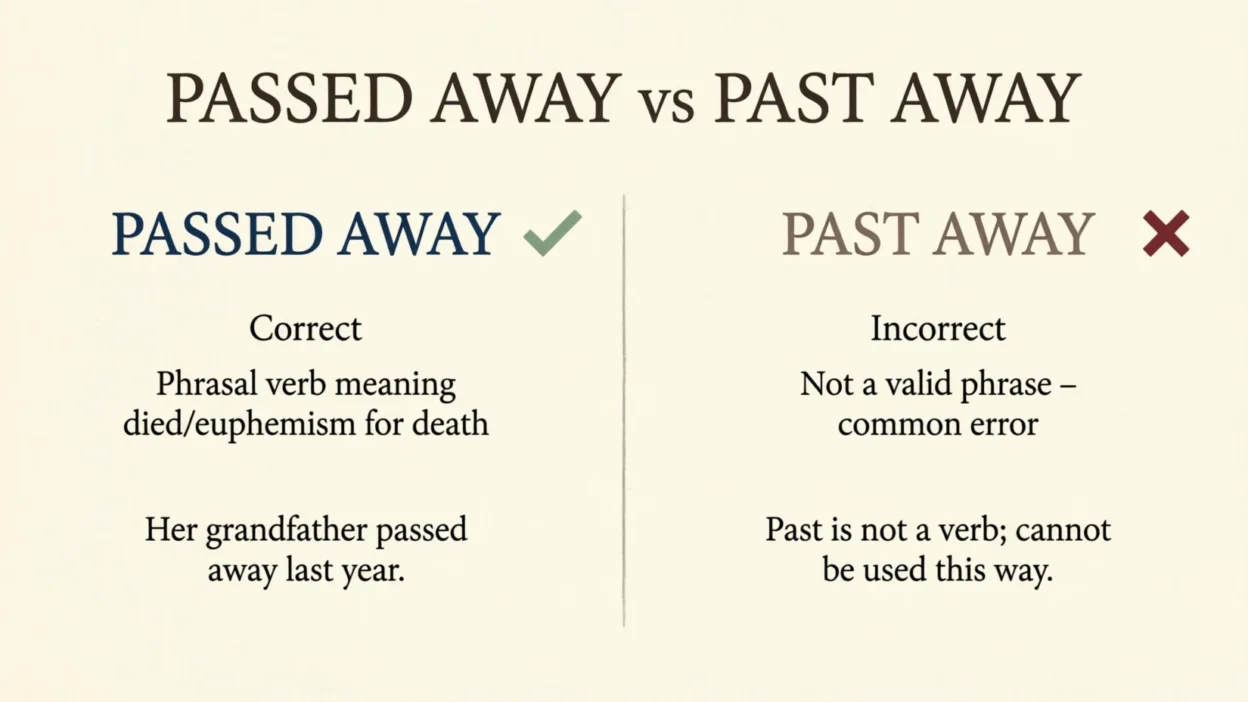
- Passed away is the correct phrase.
- Past away is grammatically incorrect.
- Her grandfather passed away peacefully last night. ✅
Incorrect example:
- Her grandfather past away peacefully last night. ❌
Simple rule:
- “Passed” is a verb.
- “Past” relates to time or direction.
What Does “Passed Away” Mean?
“Passed away” is a respectful and gentle expression meaning:
- died
- deceased
- no longer living
It is considered a softer, more compassionate alternative to directly saying:
- died
The phrase is commonly used in:
- obituaries
- condolences
- formal announcements
- sympathy messages
- conversations about loss
Examples of Passed Away
- My neighbor passed away last week.
- Her grandmother passed away peacefully.
- The famous actor passed away at age 82.
- We were saddened to hear he passed away.
Why “Past Away” Is Incorrect
“Past away” is grammatically wrong because:
- “past” is not a verb in this phrase.
The expression requires the verb:
- passed
which comes from:
- pass
The phrase literally suggests someone has “passed” from life.
Incorrect Examples
- She past away yesterday. ❌
- His uncle past away suddenly. ❌
Correct Versions
- She passed away yesterday. ✅
- His uncle passed away suddenly. ✅
Passed Away vs Past Away Comparison Table
| Phrase | Correctness | Meaning | Example |
|---|---|---|---|
| Passed away | Correct | Euphemism for died | Her aunt passed away peacefully |
| Past away | Incorrect | Grammatically incorrect | Incorrect usage |
The Grammar Behind Passed Away
The phrase uses:
- passed = past tense verb
The base verb is:
- pass
Verb Forms
| Base Verb | Past Tense | Past Participle |
|---|---|---|
| Pass | Passed | Passed |
So:
- passed away
means: - moved beyond life
Why People Confuse Passed and Past
The confusion happens because:
- both words sound identical
- English pronunciation does not clearly distinguish them
- autocorrect sometimes misses the error
Passed
Usually functions as:
- a verb
Examples:
- He passed the exam.
- Time passed quickly.
Past
Usually relates to:
- time
- position
- direction
Examples:
- The past cannot be changed.
- We walked past the building.
How to Use “Passed Away” Correctly
Use “passed away” when speaking respectfully about someone’s death.
Correct Examples
- Our family dog passed away peacefully.
- The author passed away after a long illness.
- She passed away surrounded by loved ones.
- Many fans mourned after the singer passed away.
Tone and Sensitivity of “Passed Away”
The phrase “passed away” is considered:
- compassionate
- polite
- gentle
- emotionally respectful
It softens difficult conversations and is often preferred in formal or emotional contexts.
Situations Where It’s Common
- funeral announcements
- sympathy cards
- memorial speeches
- condolence emails
- news reports
Common Mistakes With Passed Away vs Past Away
These errors are extremely common in casual writing.
Mistake 1: Using Past Instead of Passed
Incorrect:
- My grandfather past away last year. ❌
Correct:
- My grandfather passed away last year. ✅
Mistake 2: Assuming Sound Equals Spelling
Because both words sound the same, writers often choose the wrong spelling without checking grammar.
Mistake 3: Forgetting Passed Is a Verb
The phrase needs an action verb:
- passed
not:
- past
Practical Example Paragraphs
Example Using Passed Away
After battling illness for several years, Maria’s father passed away peacefully at home. Friends and family gathered to celebrate his life and share cherished memories together.
Example Showing Incorrect Usage
Although many people mistakenly write “past away” online, grammar experts agree that the correct phrase is always “passed away.”
Placement and Grammar Rules Table
| Phrase | Sentence Placement | Tone/Formality | Example Sentence |
|---|---|---|---|
| Passed away peacefully | End/middle | Respectful/formal | She passed away peacefully |
| Passed away suddenly | Middle/end | Neutral/formal | He passed away suddenly |
| Passed away last year | End | Conversational/formal | My uncle passed away last year |
| Past away | Incorrect | Nonstandard | Incorrect grammar usage |
American vs British English Differences
There are no major differences between American and British English regarding:
- passed away
Both use:
- passed away
as the standard expression.
In Both Variations
Correct:
- The actor passed away yesterday.
Incorrect:
- The actor past away yesterday.
Easy Memory Tricks
Trick 1: Passed Has “-ed”
The ending:
- -ed
usually signals:
- a verb/action
Since “passed away” involves an action, use:
- passed
Trick 2: Past Refers to Time
Think:
- the past = history
Example:
- In the past, people traveled differently.
This helps separate “past” from “passed.”
Similar English Word Confusions
People searching for “passed away vs past away” often also confuse:
- past vs passed
- affect vs effect
- than vs then
- breathe vs breath
- discreet vs discrete
These mistakes are common because English contains many homophones with different meanings.
Why Correct Usage Matters
Using the correct phrase matters because discussions about death are emotionally sensitive. Proper grammar helps communication feel:
- respectful
- polished
- compassionate
- professional
Incorrect wording may:
- distract readers
- appear careless
- weaken formal writing
- create confusion
This is especially important in:
- obituaries
- sympathy messages
- professional communication
- memorial announcements
Everyday Examples of Passed Away
Correct Usage
- His grandmother passed away last winter.
- The beloved teacher passed away peacefully.
- She passed away surrounded by family.
- We were shocked when the news reported he passed away.
Incorrect Usage
- Their dog past away recently. ❌
- She past away after surgery. ❌
FAQs About Passed Away vs Past Away
Which is correct: passed away or past away?
“Passed away” is the correct phrase.
Why is past away incorrect?
Because “past” is not the correct verb form in this expression.
Is passed away formal?
Yes. It is commonly used in respectful and formal communication.
What does passed away mean?
It is a gentle expression meaning:
- died
Can I use passed away in professional writing?
Yes. It is widely accepted in formal and respectful contexts.
Why do people confuse passed and past?
Because they sound exactly alike in spoken English.
Is passed away a euphemism?
Yes. It softens discussions about death.
Final Thoughts
Understanding the difference between passed away vs past away is important for both grammar accuracy and respectful communication. Although the two phrases sound identical, only “passed away” is grammatically correct and widely accepted in English.
Using the proper phrase helps your writing appear compassionate, polished, and professional. Whether you are writing condolences, obituaries, emails, or everyday messages, choosing “passed away” shows care and attention to language.
Actionable Takeaway
Use this quick rule:
- passed away = correct
- past away = incorrect
Easy memory trick:
- “passed” ends in “-ed,” which signals a verb/action
Before writing the phrase, ask yourself:
- “Is this describing the act of passing?”
If yes, always use: - passed away
That simple habit will help you avoid this common grammar mistake every time.

Fenwick Quentin is a creative blogging author known for his analytical yet engaging writing style.
He explores topics such as innovation, digital culture, and personal development with depth and clarity.
Through his articles, Fenwick encourages readers to think critically and embrace continuous growth.