
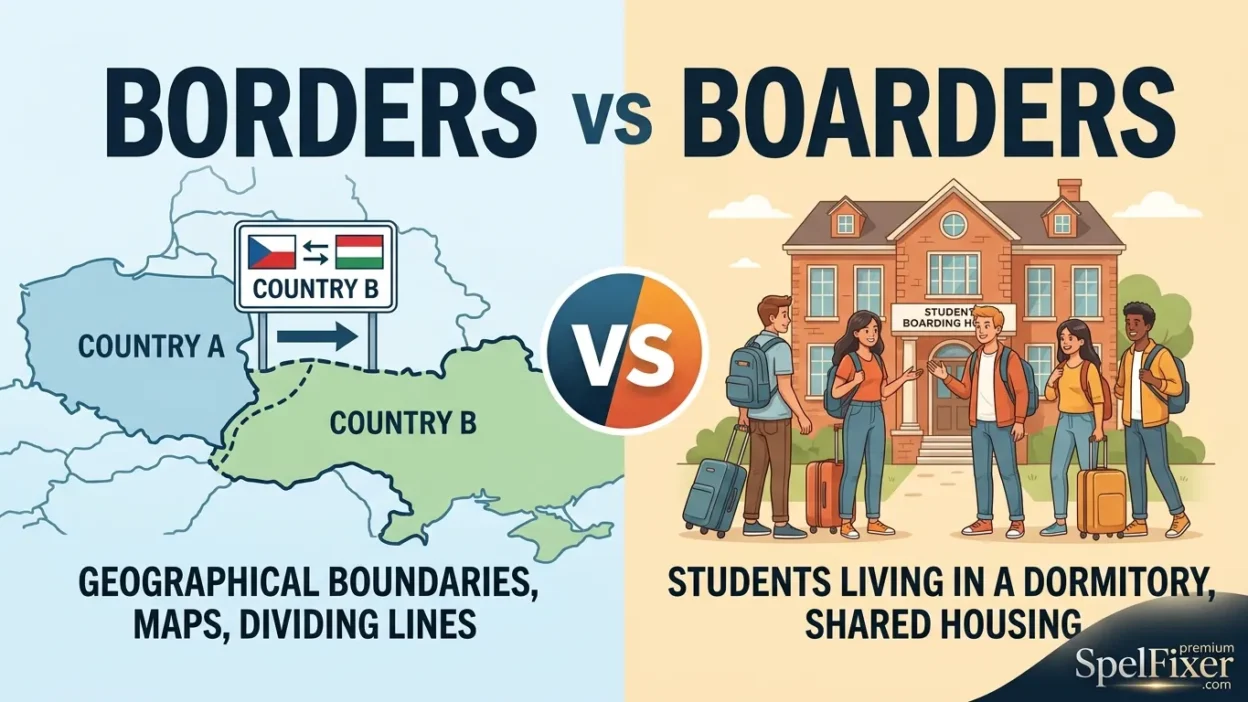
Have you ever typed borders when you meant boarders, or wondered why these two words sound almost identical but mean completely different things? You’re not alone. Borders vs boarders is a common English confusion because both words are pronounced similarly, but their meanings, spellings, and uses are not the same.
The easiest way to remember the difference is this: borders are about boundaries, edges, or countries, while boarders are people who stay somewhere by paying for accommodation or, in some contexts, people who ride boards. Once you understand the connection between border and board, choosing the correct word becomes much easier.
Quick Answer:
- Borders = boundaries, edges, or limits between places or things.
- Boarders = people who receive accommodation and meals in a place, usually by paying for them.
- Border can also be a verb meaning to share a boundary with something.
- Boarder comes from the word board, traditionally referring to meals or lodging.
- Borders and boarders are not interchangeable.
Example:
- The two countries share borders.
- The school has several boarders who live on campus.
A simple memory trick is: border = boundary; boarder = person who boards/lives somewhere.
What Does “Borders” Mean?
Borders is the plural form of border, or the third-person singular form of the verb border.
As a noun, a border is a boundary or dividing line between two places, areas, countries, or regions. It can also describe the outer edge or decorative boundary of something.
Examples of “borders” as a noun
- The two countries have strict borders.
- The map clearly shows the national borders.
- Flowers grow along the borders of the garden.
- The picture has decorative borders around it.
As a verb, borders means “is next to” or “shares a boundary with.”
Examples of “borders” as a verb
- Canada borders the United States.
- The property borders a large forest.
- The village borders the river.
So whenever you’re talking about boundaries, edges, limits, or neighboring areas, borders is usually the word you need.
What Does “Boarders” Mean?
Boarders is the plural form of boarder.
A boarder is a person who lives somewhere and receives accommodation, often along with meals, in exchange for payment. The term is particularly common when talking about boarding schools, rented accommodation, or people staying in someone else’s home.
Examples of “boarders”
- The school provides rooms for 200 boarders.
- The house has three boarders.
- The boarding school welcomes new boarders every September.
- The dormitory is reserved for student boarders.
The word boarder comes from board, which historically relates to providing food and lodging.
In some contexts, boarder can also refer to someone who participates in a board-related activity, such as a snowboarder or skateboarder, although more specific terms are normally used for those activities.
Borders vs Boarders: The Key Difference
The easiest way to understand borders vs boarders is to focus on their root words.
| Word | Meaning | Common Context | Example |
| Borders | Boundaries or edges | Countries, regions, objects | The countries share borders. |
| Boarders | People receiving lodging/meals | Schools, homes, accommodation | The boarders live at school. |
| Border | A boundary or edge | Geography, design | The border separates the regions. |
| Boarder | A person who boards/lives somewhere | Boarding schools, lodging | She is a boarder at the school. |
Remember it this way:
Border → boundary
Boarder → board/lodging
If you’re discussing a line separating two places, think border.
If you’re discussing a person staying somewhere, think boarder.
Borders Examples in Real-Life Sentences
Understanding examples is one of the fastest ways to recognize the correct spelling.
Here are several natural examples:
- The United States shares borders with Canada and Mexico.
- Guards monitor the country’s borders.
- The garden has colorful flowers along its borders.
- The designer added gold borders to the invitation.
- The river borders the northern side of the town.
- Several European countries have open borders with neighboring countries.
- The image has black borders around it.
Notice that every example involves a boundary, edge, or neighboring area.
Boarders Examples in Real-Life Sentences
Now look at examples using boarders:
- The boarding school has more than 100 boarders.
- New boarders must register before moving into the dormitory.
- The teacher organized an activity for the school’s boarders.
- Some boarders return home during the holidays.
- The house provides meals and rooms for its boarders.
- The school separates day students from boarders.
Here, boarders refers to people who stay and receive accommodation, not boundaries.
Common Mistakes With Borders and Boarders
Because borders and boarders sound so similar, spelling mistakes are common.
Mistake 1: “The countries share boarders.”
This is incorrect if you’re talking about geographical boundaries.
Correct:
The countries share borders.
Why? Because countries have borders, not people living in accommodation.
Mistake 2: “The school has 50 borders.”
This changes the meaning completely.
Correct:
The school has 50 boarders.
Here, you’re talking about students who live at the school.
Mistake 3: Confusing “border” with “board”
The extra a in boarder is important.
Think of:
- Border → boundary
- Boarder → person receiving lodging
A useful visual memory trick is to associate boarder with boarding school.
Borders vs Boarders in American and British English
The meanings and spellings of borders and boarders are essentially the same in American English and British English.
The difference is not primarily regional. Both varieties use:
- border for a boundary or edge
- boarder for someone receiving lodging or accommodation
However, the word boarder may be especially familiar in discussions of British boarding schools, where students who live at school are commonly described as boarders.
For example:
British English:
The school has 300 boarders and 500 day pupils.
American English:
The school has students who live on campus, often described as boarding students or boarders.
The exact terminology can vary by institution, but border and boarder retain their distinct meanings.
How to Remember Borders vs Boarders
If you regularly mix these words up, try this simple memory technique:
Border has no “a”
Think:
Border = boundary
There is no a after the bo.
Boarder has “board”
Think:
Boarder = someone who boards
A person staying at a boarding school can be called a boarder.
You can also remember:
Borders separate places; boarders stay in places.
This one sentence captures the difference.
Related Words You Should Know
Learning related vocabulary can make the distinction even clearer.
Words related to “border”
- Boundary
- Edge
- Limit
- Frontier
- Borderline
- Boundary line
- Borderland
- Neighboring region
Words related to “boarder”
- Board
- Boarding
- Boarding school
- Lodging
- Accommodation
- Resident
- Tenant
- Student resident
Keep in mind that these words are related but aren’t always exact synonyms. For example, a tenant usually rents a property, while a boarder traditionally receives lodging and often meals.
Is “Boarders” Ever Used for People Who Ride Boards?
Yes, but context matters.
A boarder can refer more generally to someone who participates in an activity involving a board. For example, you might encounter terms such as snowboarder or skateboarder.
However, when someone says boarders without additional context, the word most commonly refers to people who receive lodging, especially in discussions about boarding schools or accommodation.
For example:
- The school welcomed its new boarders.
- The resort attracts snowboarders from around the world.
The surrounding context makes the intended meaning clear.
Borders vs Boarders: Which One Should You Use?
Use borders when you’re talking about:
- Countries
- States or regions
- Boundaries
- Property lines
- Edges
- Decorative edges
- Areas next to something
Use boarders when you’re talking about:
- Students living at a boarding school
- People receiving accommodation
- People staying somewhere in exchange for payment
- Certain board-related activities, when the context supports it
Quick test
Ask yourself:
“Am I talking about a boundary or a person?”
If it is a boundary, use border/borders.
If it is a person staying somewhere, use boarder/boarders.
Frequently Asked Questions
Are borders and boarders the same?
No. Borders refer to boundaries or edges, while boarders usually refer to people who receive accommodation and often meals. They sound alike but have different meanings.
Is it “country borders” or “country boarders”?
The correct phrase is country borders because you’re talking about geographical boundaries between countries.
Is it “school borders” or “school boarders”?
If you’re talking about students who live at a boarding school, the correct term is school boarders.
What is the easiest way to remember borders vs boarders?
Remember: border = boundary and boarder = person who boards or receives lodging.
Do borders and boarders sound the same?
In many varieties of English, they are pronounced very similarly or identically, which is one reason they are frequently confused in writing.
Is “boarder” a person who lives at a boarding school?
Yes. A student who lives at a boarding school rather than attending only during the day can be called a boarder.
Is border an adjective or noun?
Border is commonly used as a noun and verb. As a noun, it means a boundary or edge. As a verb, it can mean to share a boundary with something.
Are borders and boarders different in British and American English?
Their core meanings and spellings are the same in both varieties. Differences may appear in the terminology surrounding boarding schools and accommodation, but border and boarder remain distinct words.
Summary:
The difference between borders vs boarders is simple once you connect each word to its meaning. Borders are boundaries, edges, or dividing lines between places or things. Boarders, on the other hand, are people who receive accommodation, particularly students living at boarding schools. The extra a in boarders is your clue that the word is connected to board and boarding.
When you’re writing, don’t rely only on pronunciation because these words can sound almost identical. Instead, consider the meaning of the sentence. If you’re discussing countries, boundaries, property lines, or edges, choose borders. If you’re talking about people living somewhere as part of a boarding arrangement, choose boarders.
Actionable Takeaway
Use this quick rule whenever you’re unsure:
Borders = boundaries.
Boarders = people who board.
For example, write “The countries share borders” but “The school welcomed its new boarders.” Remembering those two sentences will help you avoid one of the most common spelling and vocabulary mistakes in English.