Have you ever written a sentence and paused to wonder whether saw or seen is correct? You’re not alone. These two words are among the most commonly confused verbs in English because they both come from the verb see and refer to something viewed in the past.
The good news is that the difference between saw vs seen is actually quite simple. Once you understand how each word functions in a sentence, you’ll be able to use them correctly with confidence. This guide explains the meanings, grammar rules, examples, common mistakes, and easy memory tricks to help you master these two words.
Quick Answer
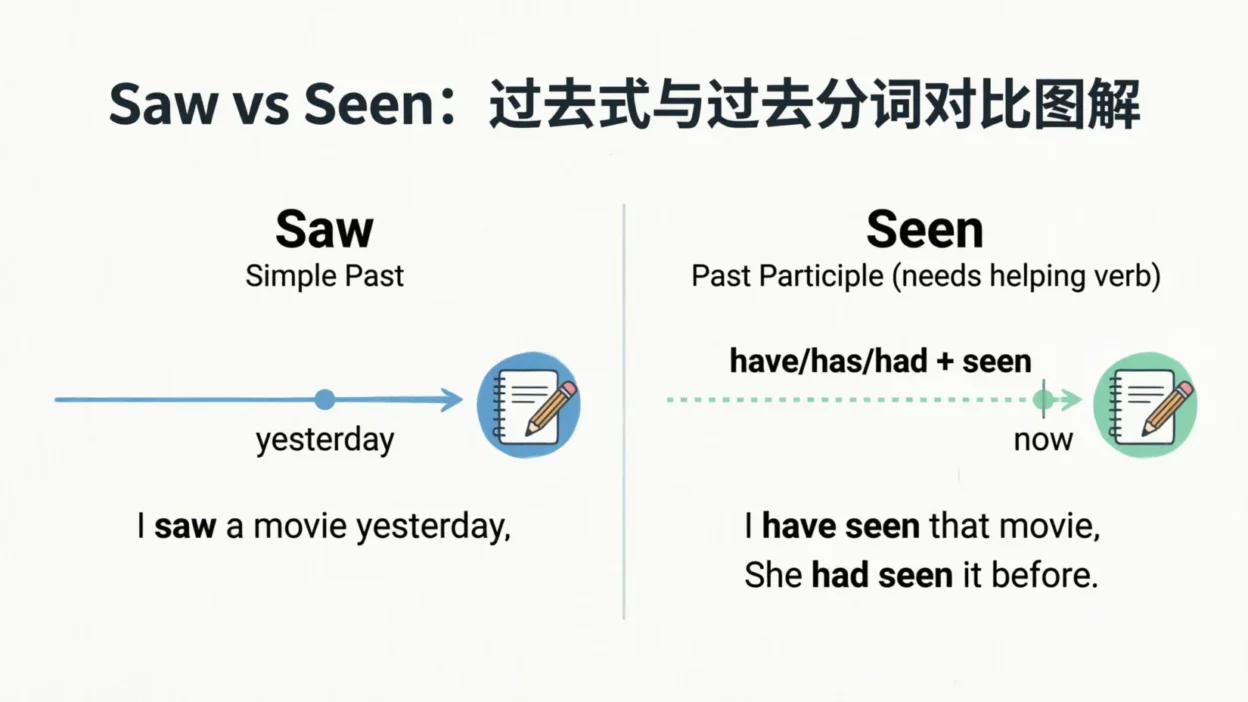
- Saw is the simple past tense of see.
- Seen is the past participle of see and must be used with a helping verb such as have, has, had, was, or were.
Examples:
- I saw a beautiful sunset yesterday. ✅
- I have seen that movie before. ✅
Incorrect:
- I seen that movie yesterday. ❌
What Does “Saw” Mean?
Definition of Saw
Saw is the simple past tense form of the verb see. It describes something you viewed or observed at a specific time in the past.
When you use saw, no helping verb is needed.
Examples of Saw in Sentences
- I saw a rainbow after the storm.
- She saw her friend at the mall.
- We saw a deer while hiking.
- They saw the announcement yesterday.
In each example, the action happened in the past and is complete.
When to Use Saw
Use saw when:
- Talking about a completed action in the past
- Mentioning a specific past time
- No helping verb is present
Examples:
- I saw him last week.
- She saw the email this morning.
- We saw the concert on Saturday.
What Does “Seen” Mean?
Definition of Seen
Seen is the past participle form of see. Unlike saw, it cannot usually stand alone as the main verb.
It must be used with a helping verb.
Examples of Seen in Sentences
- I have seen that movie twice.
- She has seen the new exhibit.
- They had seen the warning signs.
- We have never seen anything like it.
Notice that words such as have, has, and had appear before seen.
Common Helping Verbs Used with Seen
- Have
- Has
- Had
- Was
- Were
- Being
- Been
Examples:
- The suspect was seen leaving the building.
- The stars were seen clearly last night.
Saw vs Seen: Key Differences
The easiest way to understand these words is through comparison.
| Feature | Saw | Seen |
|---|---|---|
| Verb Form | Simple past tense | Past participle |
| Needs a Helping Verb | No | Yes |
| Can Stand Alone | Yes | Usually no |
| Example | I saw it yesterday. | I have seen it before. |
| Common Usage | Past actions | Perfect tenses and passive voice |
The key rule is simple:
👉 Saw stands alone.
👉 Seen needs a helper.
Why People Confuse Saw and Seen
Both Come from “See”
Since both words are forms of the same verb, it’s natural to mix them up.
Informal Speech
In some regional dialects, people incorrectly use seen in place of saw.
Example:
- I seen him yesterday. ❌
Although commonly heard in some areas, this is not considered standard English.
Similar Meanings
Both words relate to viewing or observing something, making the distinction seem less obvious.
When to Use Saw
For Specific Past Events
Use saw when referring to something that happened at a particular time.
Examples:
- I saw the game last night.
- She saw a shooting star yesterday.
Without a Helping Verb
Examples:
- We saw the parade.
- They saw the accident.
Notice that no words like have or had appear before saw.
In Everyday Conversations
Examples:
- Did you see Tom?
- Yes, I saw him this morning.
When to Use Seen
With Have, Has, or Had
Examples:
- I have seen that show before.
- She has seen the results.
- They had seen the report earlier.
In Present Perfect Tense
Examples:
- We have seen significant improvements.
- I have seen many changes over the years.
In Passive Voice
Examples:
- The suspect was seen near the bank.
- Several birds were seen in the area.
Common Mistakes to Avoid
Mistake 1: Using Seen Without a Helping Verb
Incorrect:
- I seen the movie yesterday.
Correct:
- I saw the movie yesterday.
Since there is no helping verb, saw is required.
Mistake 2: Using Saw with Have
Incorrect:
- I have saw that movie.
Correct:
- I have seen that movie.
After have, use seen.
Mistake 3: Mixing Tenses
Incorrect:
- She has saw the report.
Correct:
- She has seen the report.
Always pair seen with helping verbs.
Real-Life Examples
Example 1: Yesterday
- I saw Sarah yesterday. ✅
- I seen Sarah yesterday. ❌
Example 2: Experience
- I have seen Sarah before. ✅
- I have saw Sarah before. ❌
Example 3: Passive Voice
- The car was seen near the station. ✅
- The car was saw near the station. ❌
Easy Memory Tricks
Saw = Simple Past
Think:
- Yesterday → Saw
- Last week → Saw
- Earlier today → Saw
Examples:
- I saw it yesterday.
- We saw the game last night.
Seen = Needs a Helper
If you see:
- Have
- Has
- Had
- Was
- Were
Then seen is often the correct choice.
Examples:
- I have seen it.
- She had seen it before.
Quick Formula
- I saw ✅
- I have seen ✅
- I seen ❌
- I have saw ❌
American vs British English Differences
There is virtually no difference between American and British English when it comes to saw vs seen.
American English
- I saw him yesterday.
- I have seen him before.
British English
- I saw him yesterday.
- I have seen him before.
The grammar rules remain the same in both varieties of English.
Related Words and Verb Forms
Understanding the complete verb helps clarify the difference.
| Verb Form | Word |
|---|---|
| Base Form | See |
| Present Tense | See/Sees |
| Past Tense | Saw |
| Past Participle | Seen |
| Present Participle | Seeing |
Examples:
- I see the mountain.
- I saw the mountain yesterday.
- I have seen the mountain before.
- I am seeing the mountain now.
FAQs About Saw vs Seen
What is the difference between saw and seen?
Saw is the simple past tense, while seen is the past participle that requires a helping verb.
Is “I seen” grammatically correct?
No. Standard English requires I saw unless a helping verb is included.
Can seen be used without have or has?
Usually no. Seen typically needs a helping verb such as have, has, had, was, or were.
Is “I have saw” correct?
No. The correct phrase is I have seen.
Why do people say “I seen”?
Some regional dialects use it informally, but it is not considered standard grammar.
Which comes after “had”?
Use seen.
Example:
- They had seen the warning signs.
Is “was seen” correct?
Yes. It is a passive construction.
Example:
- The suspect was seen leaving the building.
How can I remember the difference?
Remember: Saw stands alone. Seen needs a helper.
Final Summary
Understanding saw vs seen becomes much easier when you remember their grammatical roles. Saw is the simple past tense used for actions completed in the past, while seen is the past participle that must be paired with a helping verb such as have, has, or had.
Although these words are frequently confused, mastering the distinction can instantly improve your English writing and speaking. Whether you’re writing an email, essay, report, or social media post, using the correct form helps your communication sound polished and professional.
Actionable Takeaway
Whenever you’re unsure, use this simple rule:
- If there’s no helping verb, use saw.
- If there’s a helping verb, use seen.
Remember this phrase:
Saw stands alone. Seen needs a helper.
Follow that rule, and you’ll rarely make a mistake with these commonly confused words again.

Fenwick Quentin is a creative blogging author known for his analytical yet engaging writing style.
He explores topics such as innovation, digital culture, and personal development with depth and clarity.
Through his articles, Fenwick encourages readers to think critically and embrace continuous growth.