English learners often confuse too bad and to bad because they sound almost identical when spoken. However, they have completely different grammatical roles, and in standard English, too bad is the correct phrase in most situations. Understanding the difference is simple once you know what too and to do in a sentence.
The phrase too bad can mean something unfortunate, disappointing, or worse than acceptable. It can also mean something is excessive, as in “too bad to ignore.” By contrast, to bad is usually incorrect when someone is trying to express these meanings.
The word to is normally used before a verb or as part of an infinitive or prepositional phrase. This guide explains the difference between too bad vs to bad, shows you when to use each form, and provides practical examples to help you avoid this common spelling mistake.
Quick Answer
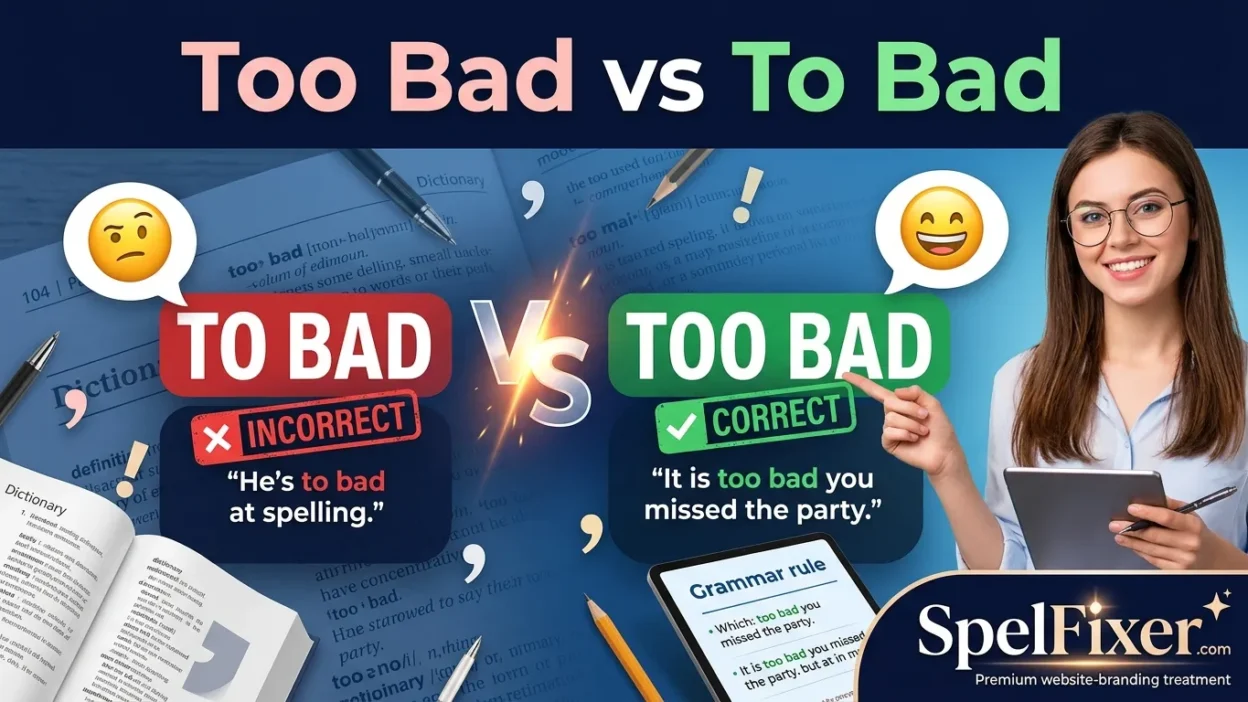
Too bad is the correct phrase when you mean unfortunate, disappointing, or excessively bad. To bad is generally incorrect in this context. Remember: too means “also” or “more than needed,” while to usually introduces a verb or shows direction. For example, “It’s too bad you missed the bus.”
Why Do People Confuse Too Bad and To Bad?
The main reason is pronunciation.
In everyday speech, too and to often sound exactly the same. This makes the mistake difficult to notice when listening or speaking.
However, their meanings and grammatical functions are different:
- Too = excessively, more than necessary, or also
- To = used before a verb or to show direction, movement, or relationship
- Bad = an adjective describing something unpleasant, poor, or undesirable
So when you want to say that something is unfortunate, the correct expression is too bad.
Example:
It’s too bad you couldn’t come.
Here, too bad means that it is unfortunate that the person could not come.
What Does “Too” Mean?
Too is an adverb with several common meanings.
It can mean more than necessary:
- This coffee is too hot.
- The box is too heavy.
- The movie was too long.
It can also mean also:
- I want to go too.
- She likes chocolate too.
In too bad, the word too can express an excessive degree:
- The weather is too bad to go outside.
It can also form the common expression too bad, meaning unfortunate or disappointing:
- Too bad you missed the game.
What Does “To” Mean?
To is a very common English word with several grammatical uses.
It often comes before a verb in the infinitive form:
- I want to learn.
- She needs to study.
- They decided to leave.
It can also indicate direction:
- We went to school.
- He walked to the store.
- She traveled to London.
Because to does not normally mean “excessively” or “unfortunate,” to bad is not the standard spelling of the expression.
Too Bad vs To Bad: Comparison Table
| Phrase | Correct? | Meaning | Example |
|---|---|---|---|
| too bad | ✅ Yes | Unfortunate or excessively bad | It’s too bad you missed it. |
| to bad | ❌ Usually no | Not the standard expression | ❌ It’s to bad you missed it. |
| too | ✅ Yes | Excessively or also | The soup is too salty. |
| to | ✅ Yes | Direction or infinitive marker | I want to leave. |
When Should You Use “Too Bad”?
Use too bad when you mean that something is unfortunate, disappointing, or undesirable.
Example 1
It’s too bad that you missed the meeting.
Meaning: It is unfortunate that you missed the meeting.
Example 2
Too bad we arrived late.
Meaning: It is unfortunate that we arrived late.
Example 3
That’s too bad.
This is a very common expression used when reacting to disappointing news.
Example 4
The weather is too bad for a picnic.
Here, too bad means the weather is excessively bad.
Example 5
The road conditions are too bad to drive safely.
Here, too means more than acceptable or manageable.
When Can “To” Appear Before “Bad”?
Although to bad is not the correct spelling of the expression too bad, the words to and bad can appear next to each other in unusual grammatical situations.
For example:
We went from good to bad very quickly.
Here, to shows a change from one condition to another.
Another example:
The situation changed from bad to bad.
This sentence is grammatically possible but unusual because the condition does not actually change.
So to bad is not always impossible as two separate words. The important point is that it does not replace too bad in the common expression meaning “unfortunate.”
10+ Examples of “Too Bad”
- It’s too bad you couldn’t join us.
- That’s too bad.
- Too bad we missed the train.
- It’s too bad that the event was canceled.
- The weather is too bad for outdoor activities.
- The traffic was too bad to drive quickly.
- The food was too bad to finish.
- It’s too bad she forgot her phone.
- Too bad you didn’t know about the sale.
- The damage was too bad to ignore.
- The noise was too bad for me to sleep.
- It’s too bad they had to leave early.
Notice that too bad can have slightly different meanings depending on context.
Common Mistakes With Too Bad and To Bad
Mistake 1: Writing “to bad”
❌ It’s to bad you missed the party.
✅ It’s too bad you missed the party.
Mistake 2: Confusing “too” with “to”
❌ The weather is to cold.
✅ The weather is too cold.
Mistake 3: Assuming similar pronunciation means identical usage
Although too and to often sound alike, they are not interchangeable in writing.
Mistake 4: Forgetting the second meaning of “too”
Remember that too can mean also:
- I want to go too.
It can also mean more than necessary:
- This bag is too heavy.
Memory Trick: Too Bad or To Bad?
Use this simple trick:
Too = more than enough / also
To = direction or before a verb
If you mean unfortunate, choose:
👉 TOO BAD
Think:
“It’s too bad.”
If you’re talking about going somewhere or doing something:
“I want to go.”
A quick rule:
Bad news? → TOO BAD.
Direction or verb? → TO.
American vs British English
There is no major spelling difference between American and British English for too bad.
Both varieties use:
- too bad
- to bad only when to and bad happen to serve separate grammatical functions
For example:
American English:
It’s too bad you missed the train.
British English:
It’s too bad you missed the train.
The phrase is standard in both forms of English.
Similar Words and Phrases
Several expressions are related to too bad:
That’s unfortunate
A more formal way to express disappointment.
That’s unfortunate. We’ll have to try again.
What a shame
A natural expression for something disappointing.
What a shame you couldn’t come.
Sadly
An adverb used to describe an unfortunate situation.
Sadly, the event was canceled.
Unfortunately
A common formal or neutral alternative.
Unfortunately, we cannot attend.
Too difficult
Here, too has its normal meaning of excessive degree.
The question is too difficult for me.
Final Verdict
Too bad is the correct phrase when you mean unfortunate, disappointing, or excessively bad.
Use too when it means more than necessary or when it forms the expression too bad.
Use to for purposes such as introducing an infinitive or showing direction.
So:
✅ It’s too bad you missed the bus.
❌ It’s to bad you missed the bus.
The easiest rule to remember is: If you mean “unfortunate,” write “too bad.”
Frequently Asked Questions
Is “too bad” correct English?
Yes. Too bad is correct English and is commonly used to express disappointment, regret, or an unfortunate situation.
Is “to bad” ever correct?
Yes, but only when to and bad have separate grammatical roles. It is not correct as a replacement for the expression too bad.
What does “too bad” mean?
Too bad can mean “unfortunate” or “disappointing.” It can also mean that something is excessively bad, depending on context.
Is “too bad” one word?
No. Too bad consists of two separate words.
What is the difference between too and to?
Too can mean “also” or “more than necessary.” To commonly introduces an infinitive or indicates direction or movement.
Can I say “That’s too bad”?
Yes. That’s too bad is a common and natural English expression used when reacting to disappointing news.
Is “too bad” formal or informal?
Too bad is generally conversational and natural. In formal writing, unfortunate or unfortunately may sometimes be more appropriate.
Remember This
Too bad = unfortunate or excessively bad.
To = direction, relationship, or infinitive marker.
When you’re talking about disappointing news, remember:
Conclusion
The difference between too bad vs to bad is easy once you understand the roles of too and to. Too bad is the standard phrase when you mean something is unfortunate, disappointing, or excessively bad. Because too and to often sound alike, this is a common spelling mistake for English learners.
Whenever you want to react to disappointing news, use too bad: “That’s too bad” or “It’s too bad you couldn’t come.” Use to when it has its normal grammatical function, such as in “I want to go” or “We went to school.” Remembering this simple distinction will make your English writing clearer and more accurate.