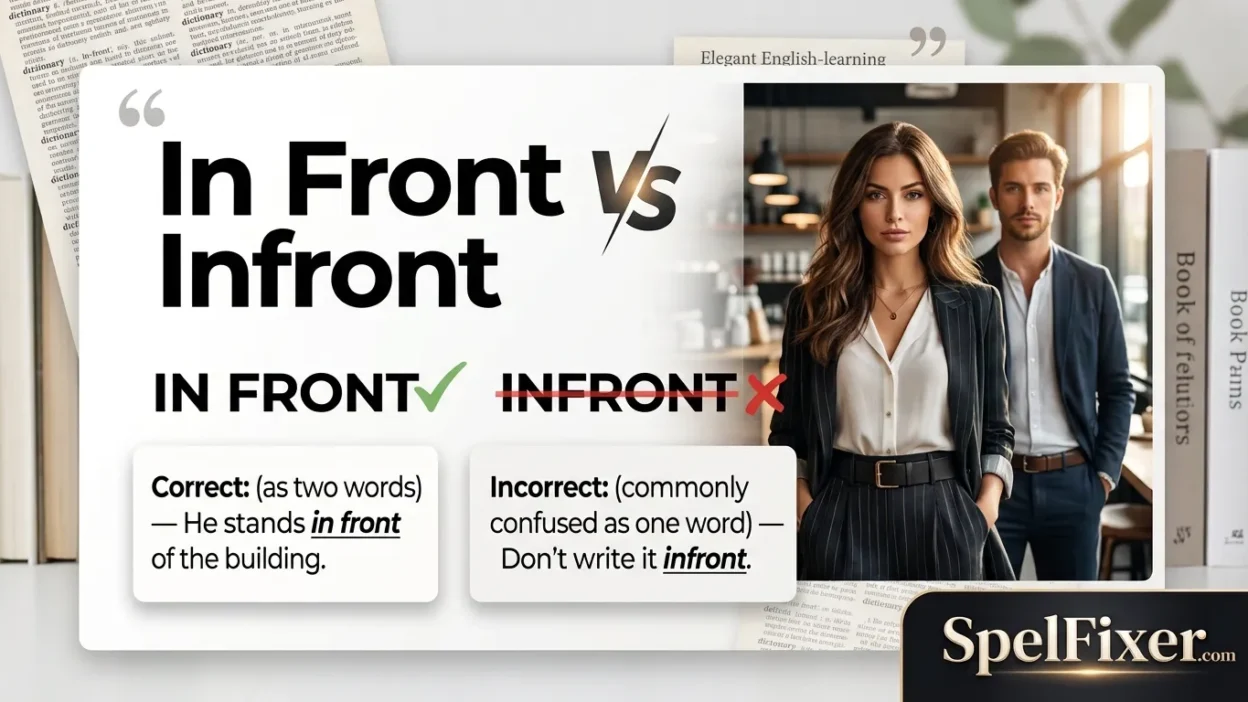
If you are wondering whether to write in front or infront, the correct form in standard English is in front two separate words. Infront is generally considered an incorrect spelling when used as the prepositional phrase meaning “ahead of” or “before.” For example, you should write, “The car is parked in front of the house,” not “The car is parked infront of the house.”
This confusion is common because English contains many compound words, and some phrases that look like they should be combined are actually written separately. Learning the difference between in front and infront is simple once you understand how the phrase works. In this guide, you will learn its meaning, correct usage, examples, common mistakes, and an easy memory trick.
Quick Answer
In front is the correct spelling in standard English. It means “ahead of,” “before,” or “at the forward side of something.” Infront is not normally used as a standard English word. Always write in front, usually followed by of when identifying what or whom something is ahead of.
Why Do People Confuse It?
People often confuse in front with infront because the phrase is pronounced smoothly in everyday speech.
English also has many words that combine naturally, such as:
- inside
- indoors
- beforehand
- behind
- upfront
Because of these examples, it can seem logical to write infront as one word. However, in front remains a two-word phrase.
The safest rule is simple: when you mean “ahead of” or “before,” write in front.
First Word: “In”
In is a preposition that can describe position, location, or inclusion.
Examples:
- The keys are in the drawer.
- She is in the classroom.
- There is water in the bottle.
- He lives in Lahore.
In in front, the word in helps form a phrase describing position.
Second Word: “Front”
Front refers to the forward part or side of something.
Examples:
- The front of the building is beautiful.
- Please sit in the front.
- There is a garden at the front of the house.
Together, in front describes something positioned ahead of another person or thing.
In Front vs Infront: Comparison Table
| Form | Correct? | Meaning | Example |
|---|---|---|---|
| in front | ✅ Yes | Ahead of or before | She stood in front of me. |
| infront | ❌ No | Not standard English in this usage | Avoid infront. |
| in front of | ✅ Yes | Ahead of someone/something | The car is in front of the house. |
When Should You Use “In Front”?
Use in front when describing a position, location, or order.
Use “in front of” for location
When one person or thing is positioned ahead of another, use in front of.
Examples:
- The teacher is standing in front of the class.
- A bus stopped in front of our house.
- She parked her bicycle in front of the store.
Use “in front” without “of”
You can also use in front when the thing being referred to is already understood.
Examples:
- Please sit in front.
- There is plenty of space in front.
- He was walking in front.
10+ Examples of “In Front”
Here are practical examples showing the correct usage:
- The school is in front of the park.
- She stood in front of the mirror.
- My car is parked in front of the house.
- Please wait in front.
- He was sitting in front of me.
- The children are playing in front of the building.
- A large tree stands in front of our office.
- She walked in front while we followed behind.
- The teacher wrote the answer in front of the students.
- There is a bus stop in front of the hotel.
- Don’t stand in front of the television.
- He placed the chair in front of the desk.
Common Mistakes
Mistake 1: Writing “infront”
❌ The shop is infront of the school.
✅ The shop is in front of the school.
Mistake 2: Joining the words
Because in front sounds like one unit when spoken, learners sometimes combine it.
❌ She stood infront of me.
✅ She stood in front of me.
Mistake 3: Confusing “in front” with “front”
These expressions are related but are not always interchangeable.
- The front of the house is painted white.
- The car is in front of the house.
The first describes a part or side. The second describes position.
Mistake 4: Using “in front” when “before” is intended
In front of can describe physical position, while before can describe time or sequence.
- He stood in front of me. → Position
- He arrived before me. → Earlier in time
Memory Trick
Remember:
IN + FRONT = IN FRONT
Think of front as a place or position. If something is ahead of you, it is in front of you.
A quick memory sentence:
So always write:
✅ in front
Not:
❌ infront
American vs British English
There is no major American-versus-British spelling difference for this phrase.
Both American English and British English normally use:
in front
Examples:
- American English: The car is in front of the house.
- British English: The car is in front of the house.
The same two-word spelling is standard in both varieties.
Similar Words
Several expressions are related to in front, but their meanings can differ slightly.
Ahead of
Means farther forward or before someone/something.
- She walked ahead of us.
Before
Usually refers to earlier time or order.
- He arrived before me.
Behind
Means at or toward the back of something.
- The garage is behind the house.
At the front
Refers to a position at the forward part of something.
- She is sitting at the front of the classroom.
In front of
Specifically describes something positioned ahead of another person or thing.
- The bus is in front of the station.
Final Verdict
The correct form is in front—two separate words.
Use in front of when you want to show that someone or something is positioned ahead of another person or thing.
Infront should generally be avoided in standard English writing.
Correct: The teacher is standing in front of the students.
Incorrect: The teacher is standing infront of the students.
Frequently Asked Questions
Is “infront” one word?
No. In standard English, the phrase is written in front, as two words.
Is “in front of” correct grammar?
Yes. In front of is a standard English prepositional phrase used to describe position.
Which is correct: “in front” or “infront”?
In front is correct. Infront is not the standard spelling for this phrase.
Should I write “in front of me”?
Yes. For example: “The person is standing in front of me.”
Is “in front” used in American English?
Yes. In front is standard in American English.
Is “in front” used in British English?
Yes. British English also normally uses in front as two words.
Can I use “in front” without “of”?
Yes, when the reference is already clear.
Example: “Please stand in front.”
What is the opposite of “in front of”?
The usual opposite is behind.
Example:
- The car is in front of the house.
- The garage is behind the house.
Remember This
In front = correct ✅
Infront = incorrect in standard English ❌
When you mean ahead of, before, or at the forward side of, use in front. When identifying what something is ahead of, use in front of.
Conclusion
The difference between in front and infront is straightforward: in front is the standard and correct form. It is written as two separate words and is commonly used to describe the position of a person or thing ahead of another person or thing.
To avoid this common spelling mistake, remember that front stays separate from in. Whether you are writing for school, work, everyday communication, or formal English, choose in front rather than infront.
Actionable takeaway: Whenever you mean “ahead of,” write in front. If another person or object follows the phrase, use in front of.