Have you ever paused while writing a sentence and wondered whether “as soon as” or “once” sounds more natural? You’re not alone. Both expressions talk about something happening after another event, so they can often seem interchangeable.
The good news is that the difference is simple once you understand the emphasis of each phrase. In this guide, I’ll explain as soon as vs once with clear meanings, examples, grammar rules, common mistakes, and practical tips so you can confidently choose the right expression in everyday and formal English.
Quick Answer:
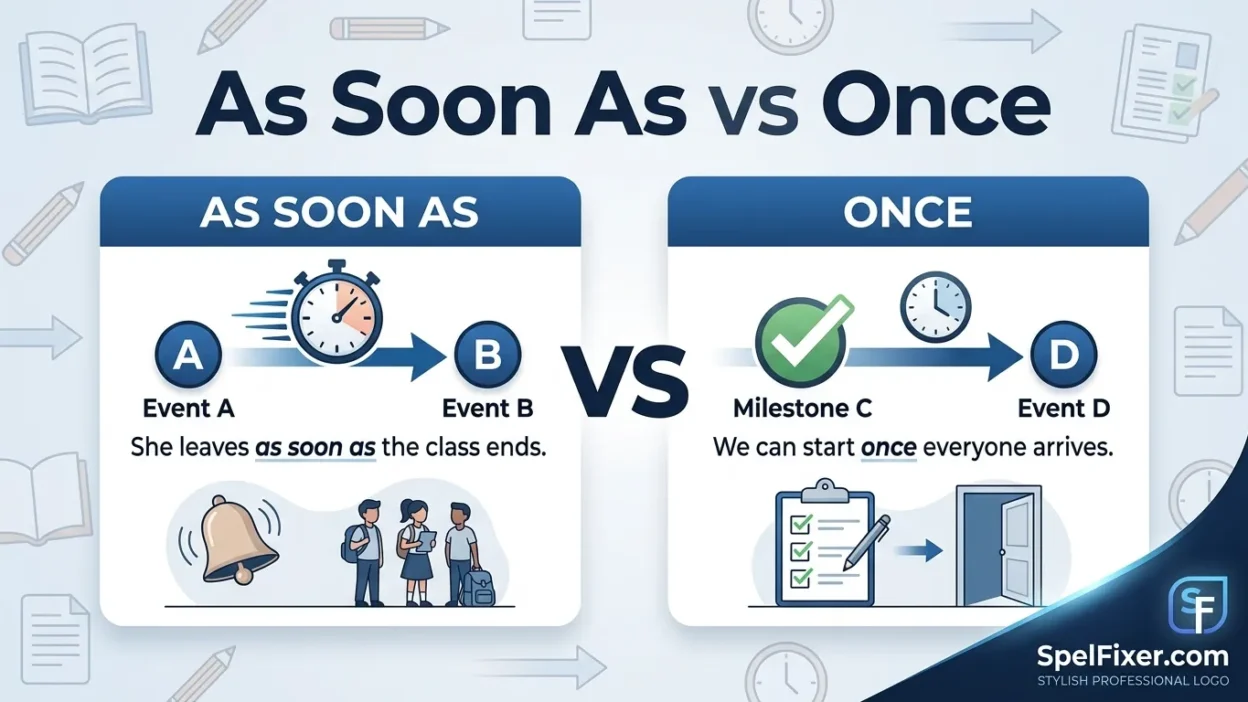
“As soon as” means immediately after something happens. It emphasizes that there is little or no delay.
“Once” means after or when something has happened or been completed. It emphasizes that a condition or event must happen first, but it does not necessarily suggest immediate action.
Compare these examples:
- Call me as soon as you arrive.
→ Call me immediately after you arrive. - Call me once you arrive.
→ Call me after you arrive.
Both sentences are correct, but “as soon as” puts more emphasis on timing and immediacy.
What Does “As Soon As” Mean?
As soon as is a conjunction used to show that one action happens immediately or very shortly after another action.
It connects two events and emphasizes the short time between them.
Examples of “as soon as”
- I’ll call you as soon as I get home.
- Please send me the document as soon as you finish it.
- She started cooking as soon as she returned from work.
- Let me know as soon as you hear anything.
- We left as soon as the meeting ended.
In each example, the second action follows the first with little delay.
Simple formula
Action 1 + as soon as + Action 2
For example:
I’ll text you as soon as I arrive.
The speaker intends to text immediately after arriving.
What Does “Once” Mean?
Once can mean after something happens, when something happens, or provided that a particular condition has been met.
When used as a conjunction, it often introduces a situation that needs to happen before another action can occur.
Examples of “once”
- I’ll call you once I get home.
- Once the food is ready, we can eat.
- You can leave once the work is finished.
- Once she understands the problem, she’ll know what to do.
- We can start once everyone arrives.
Unlike as soon as, “once” does not strongly emphasize that the next action happens immediately.
It simply establishes a sequence:
First this happens → then that happens.
As Soon As vs Once: Key Difference
The main difference is immediacy versus sequence or condition.
| Feature | As Soon As | Once |
| Basic meaning | Immediately after | After/when |
| Emphasis | Speed and timing | Sequence or condition |
| Suggests little delay? | Yes | Not necessarily |
| Common in conversation? | Very common | Very common |
| Can introduce a condition? | Less commonly | Yes |
| Example | Call me as soon as you arrive. | Call me once you arrive. |
Consider this:
I’ll start studying as soon as dinner is over.
This suggests the speaker will begin studying immediately after dinner.
I’ll start studying once dinner is over.
This simply means dinner must finish before studying begins. The speaker may start immediately, but the sentence does not emphasize that.
When Should You Use “As Soon As”?
Use as soon as when the timing between two events matters.
It is especially useful when you want to communicate urgency, immediacy, or a quick response.
Example 1: Work
Please email the report as soon as you finish it.
The speaker wants the report quickly after it is completed.
Example 2: Travel
Let me know as soon as you reach the airport.
The speaker wants to be informed immediately after arrival.
Example 3: Everyday conversation
I’ll message you as soon as I wake up.
This suggests messaging will happen shortly after waking.
Example 4: Instructions
Turn off the machine as soon as you notice a problem.
The phrase communicates urgency.
When Should You Use “Once”?
Use once when you want to emphasize that one event, condition, or requirement must happen before another event.
Example 1: Completing a task
You can watch TV once you finish your homework.
Finishing the homework is the condition that comes first.
Example 2: Making a decision
We can make a decision once we have all the information.
Having the information is necessary before making the decision.
Example 3: Starting an activity
Once everyone is ready, we can begin.
The focus is on readiness rather than immediate timing.
Example 4: Learning
Once you understand the basic rule, the rest becomes easier.
Here, “once” introduces a condition or stage rather than simply describing a short time interval.
Can “As Soon As” and “Once” Be Interchanged?
Sometimes, yes.
For example:
I’ll call you as soon as I arrive.
and
I’ll call you once I arrive.
Both are grammatically correct and communicate essentially the same basic sequence.
However, they are not always identical in tone.
As soon as = emphasizes immediate timing.
Once = emphasizes completion, sequence, or a condition.
That small difference can affect which phrase sounds more natural in a particular sentence.
As Soon As vs Once in Future Sentences
One important grammar rule involves talking about the future.
After as soon as and once, English normally uses the present simple, not “will,” when the clause refers to a future event.
Correct:
I’ll call you as soon as I arrive.
We’ll leave once she gets here.
Usually incorrect:
I’ll call you as soon as I will arrive.
We’ll leave once she will get here.
The main clause can use will, but the time clause generally uses the present simple.
Pattern
I’ll + verb + as soon as/once + present simple
For example:
I’ll send the file as soon as I finish it.
We’ll start once everyone arrives.
This is an important rule for learners of English.
Common Mistakes to Avoid
1. Using “will” after “as soon as”
❌ I’ll call you as soon as I will arrive.
✅ I’ll call you as soon as I arrive.
2. Assuming “once” always means immediately
“Once” does not necessarily mean immediately.
Once the meeting ends, I’ll review the notes.
This tells us what happens afterward, but it does not strongly promise an immediate action.
3. Using “as soon as” when there is no urgency
Sometimes once sounds more natural when the first event is simply a requirement.
You can use the computer once the update is complete.
The important point is that the update must be complete.
4. Confusing “once” with “one time”
“Once” has several meanings.
It can mean:
- One time: I visited London once.
- After/when: Once you finish, let me know.
- Formerly: She once lived here.
Context determines the meaning.
As Soon As vs Once in American and British English
Both as soon as and once are standard in American and British English.
There is no major regional grammar difference that makes one expression exclusively American or British.
For example, both varieties commonly use:
I’ll call you as soon as I get home.
and:
We can leave once everyone is ready.
The choice generally depends on meaning, context, emphasis, and personal style, rather than nationality.
In both American and British English, as soon as is particularly natural when the speaker wants to stress immediacy.
Which One Sounds More Natural?
The answer depends on what you want to communicate.
Choose as soon as when you mean:
- immediately after
- without delay
- at the earliest possible moment
- quickly after an event
Choose once when you mean:
- after
- when
- after a condition is satisfied
- when something is completed
A useful memory trick
Think:
As soon as = How quickly?
Once = What needs to happen first?
This simple distinction can help you choose the right expression quickly.
Real-Life Examples: As Soon As vs Once
Here are some practical examples that show the difference naturally.
Example 1
As soon as:
Send me a message as soon as you arrive.
Focus: Send it immediately.
Once:
Send me a message once you arrive.
Focus: After you arrive, send it.
Example 2
As soon as:
I’ll start cooking as soon as I get home.
Focus: Very little delay.
Once:
I’ll start cooking once I get home.
Focus: Getting home comes first.
Example 3
As soon as:
Tell me as soon as you know the answer.
Focus: Tell me quickly.
Once:
Tell me once you know the answer.
Focus: Tell me after you know it.
These pairs demonstrate why the expressions can sometimes replace each other without changing the basic meaning, while still creating a slightly different emphasis.
FAQs
Is “as soon as” the same as “once”?
Not exactly. They can sometimes mean the same thing, but as soon as emphasizes immediate timing, while once usually emphasizes sequence or a condition.
Is “once” more formal than “as soon as”?
Not necessarily. Both are widely used in everyday and formal English. The best choice depends on the context and intended meaning.
Can I use “will” after “as soon as”?
Generally, no, when you are referring to a future event. Use the present simple instead: “I’ll call you as soon as I arrive.”
Can “once” mean “immediately”?
It can sometimes imply that something happens after another event, but once itself does not strongly communicate immediacy. As soon as is better when “immediately” is important.
Which is better: “once I arrive” or “as soon as I arrive”?
Both are grammatically correct. Use as soon as I arrive when you want to emphasize that something will happen immediately after arrival.
Is “as soon as” correct in American English?
Yes. As soon as is completely standard in American English and is also commonly used in British English.
Is “once” a conjunction?
Yes. Once can function as a conjunction meaning after or when, as in “Once you finish your work, you can leave.”
What is the easiest way to remember the difference?
Remember: as soon as = immediately after, while once = after/when a condition or event has occurred.
Summary
The difference between as soon as vs once is small but useful. As soon as emphasizes that one event happens immediately or very shortly after another.
Once focuses more on sequence, completion, or a condition that must be satisfied first. Because of this, the two expressions can often appear in similar sentences without making the sentence grammatically wrong.
When you are writing or speaking, ask yourself what you want to emphasize. If you mean “immediately after,” choose as soon as. If you simply mean “after this happens” or want to establish a condition, once is usually the better choice. And when discussing future events, remember to use the present simple after these time expressions.
Actionable Takeaway
Before choosing between as soon as and once, ask: Am I emphasizing speed, or am I simply describing what must happen first? Choose as soon as for immediate timing and once for sequence or conditions.