Have you ever written bussing and wondered whether it should actually be busing? You’re not alone. These two spellings often confuse writers because both appear in dictionaries, style guides, and everyday writing. However, they are not always interchangeable, and the preferred spelling can depend on context, region, and intended meaning.
Understanding the difference between bussing vs busing is important for students, professionals, content writers, and anyone who wants to write clearly and accurately. In this guide, you’ll learn the meanings, proper usage, examples, common mistakes, and key grammar rules surrounding these commonly confused words.
Quick Answer
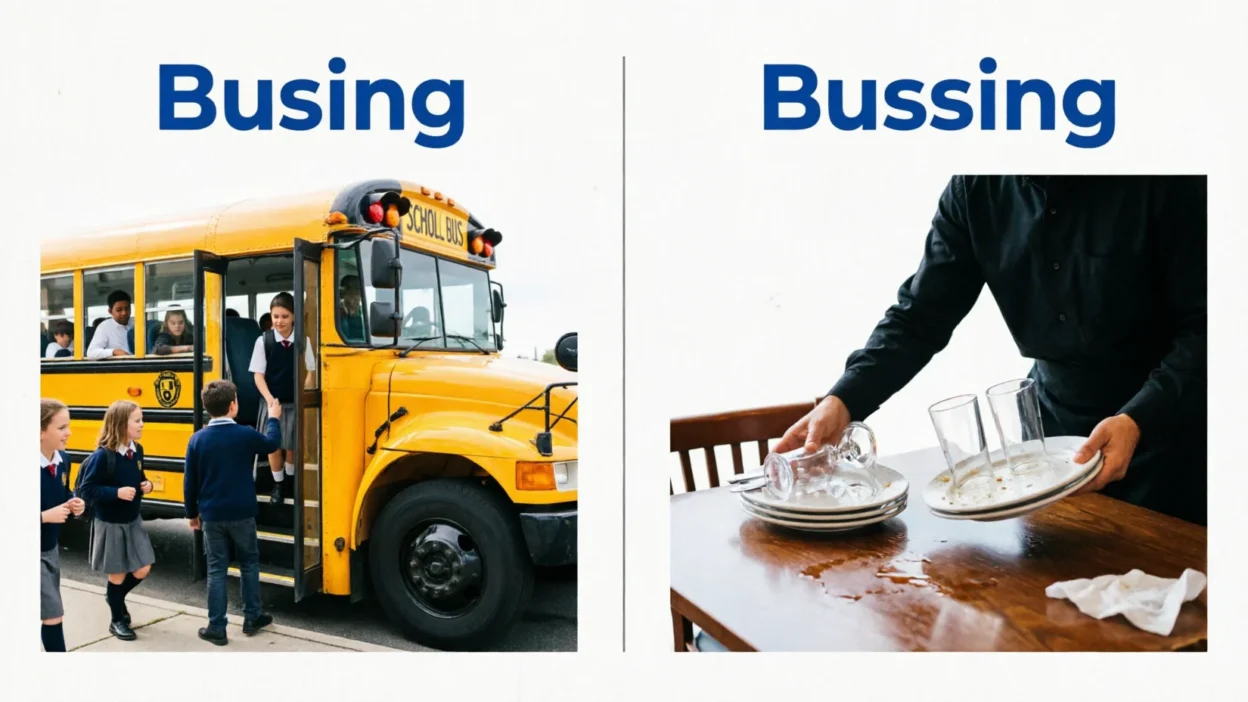
Both “bussing” and “busing” are correct spellings of the verb “bus.” However, busing is generally preferred in modern American and British English when referring to transporting people by bus, while bussing is often used in restaurant contexts, such as clearing tables.
Understanding the Meaning of Bussing and Busing
The words bussing and busing come from the verb bus, which means to transport people by bus or to clear tables in a restaurant.
Although both spellings are accepted, usage patterns have evolved over time.
Busing
Busing is the more common spelling when discussing transportation.
Examples:
- The school district is busing students to neighboring schools.
- The city is busing workers to the construction site.
- The company is busing employees from the parking lot.
Bussing
Bussing is frequently associated with restaurant work.
Examples:
- She spent the evening bussing tables at the restaurant.
- The waiter was bussing dishes after dinner service.
- Students earned extra money by bussing tables on weekends.
Bussing vs Busing: Key Differences
| Feature | Bussing | Busing |
|---|---|---|
| Common meaning | Clearing restaurant tables | Transporting people by bus |
| Modern preference | Restaurant industry | Transportation contexts |
| Accepted spelling | Yes | Yes |
| Common in American English | Less common | More common |
| Common in British English | Less common | More common |
The distinction isn’t always mandatory, but following common usage improves clarity.
Why Are There Two Spellings?
The confusion comes from English spelling conventions.
When adding -ing to words ending in a consonant, English sometimes doubles the final consonant. As a result, bus can become either:
- busing
- bussing
Over time, style guides and dictionaries began favoring busing for transportation-related writing because it reduces confusion and looks cleaner.
Meanwhile, the restaurant industry continued using bussing tables, making the double-s version common in hospitality settings.
When to Use Busing
Use busing when discussing transportation, especially involving buses carrying passengers.
Examples
- The school is busing children across the district.
- The government began busing refugees to temporary housing.
- Workers are busing between offices daily.
- The company is busing employees to the event.
Common Transportation Contexts
- School transportation
- Public transit programs
- Employee transportation
- Event shuttles
- Community services
In these situations, busing is generally the preferred spelling.
When to Use Bussing
Use bussing when referring to restaurant duties involving clearing tables.
Examples
- He started his career by bussing tables.
- The restaurant hired extra staff for bussing duties.
- She spent the night bussing plates and glasses.
- Bussing tables helped him learn customer service skills.
Hospitality-Related Uses
- Clearing dishes
- Resetting tables
- Assisting servers
- Restaurant support tasks
Many restaurant managers and hospitality guides still favor bussing for these tasks.
Examples in Everyday Sentences
Seeing the words in context makes the distinction easier.
Busing Examples
- The district is busing students to a new campus.
- The city started busing residents during road construction.
- Employees are busing from remote parking areas.
Bussing Examples
- The teenager worked weekends bussing tables.
- She spent the evening bussing trays and dishes.
- Bussing tables taught him teamwork and efficiency.
Common Mistakes With Bussing and Busing
Writers frequently make several errors when using these spellings.
Mistake 1: Assuming One Is Always Wrong
Many people believe only one spelling is correct.
Correct:
- Both spellings are accepted.
Mistake 2: Using Bussing for School Transportation
Less preferred:
- The district is bussing students.
Preferred:
- The district is busing students.
Mistake 3: Ignoring Context
Using the same spelling everywhere may create confusion.
Examples:
- Busing students sounds natural.
- Bussing tables sounds natural.
Matching the spelling to the context improves readability.
American vs British English Differences
Unlike many English word pairs, there is not a major difference between American and British English regarding these spellings.
American English
- Usually prefers busing for transportation.
- Often uses bussing in restaurant settings.
British English
- Generally follows the same pattern.
- Transportation contexts commonly use busing.
In both varieties, readers are more likely to encounter busing when discussing transportation.
Helpful Memory Trick
A simple trick can help you remember the difference.
Remember This:
Busing = Bus transportation
Think of:
Bus + ing = Busing
For Restaurant Work
Bussing = Clearing tables
Many people associate the extra s with service staff.
While not a formal grammar rule, this memory aid can be helpful.
Related Words and Synonyms
Understanding related terms can improve your vocabulary.
Related Transportation Terms
- Transporting
- Shuttling
- Conveying
- Carrying passengers
- Transit service
Related Restaurant Terms
- Clearing tables
- Table service
- Food service
- Restaurant support
- Waitstaff assistance
These LSI keywords help clarify meaning while improving search relevance.
Frequently Asked Questions
Is bussing or busing correct?
Both spellings are correct. However, busing is generally preferred for transportation, while bussing is commonly used for restaurant table-clearing duties.
Which spelling is more common today?
Busing is more common overall, especially in news articles, educational materials, and transportation-related writing.
What does bussing tables mean?
Bussing tables means clearing dishes, glasses, and utensils from restaurant tables after customers finish eating.
Is bussing students correct?
It is technically acceptable, but busing students is the preferred and more widely recognized spelling.
Do dictionaries recognize both spellings?
Yes. Most major dictionaries list both busing and bussing as valid forms.
Is there a difference in pronunciation?
No. Both words are pronounced the same way.
Should I use bussing or busing in formal writing?
For transportation contexts, use busing. For restaurant-related tasks, bussing is often the preferred choice.
Why do restaurants use bussing?
The spelling became established within the hospitality industry and remains widely used for table-clearing duties.
Summary
The debate over bussing vs busing comes down largely to context. Both spellings are correct, but modern usage has created a practical distinction. Busing is generally preferred when discussing transportation, especially involving schools, organizations, or public transit systems. Bussing, meanwhile, remains common in restaurants and hospitality settings where employees clear tables and assist servers.
Understanding this subtle difference can make your writing clearer and more professional. While readers will likely understand either spelling, choosing the version that best fits the situation helps avoid confusion and demonstrates strong language skills.
Actionable Takeaway
When writing about transportation, choose busing. When writing about restaurant table-clearing duties, choose bussing. Following this simple guideline will help you use both spellings confidently and accurately in everyday communication.