
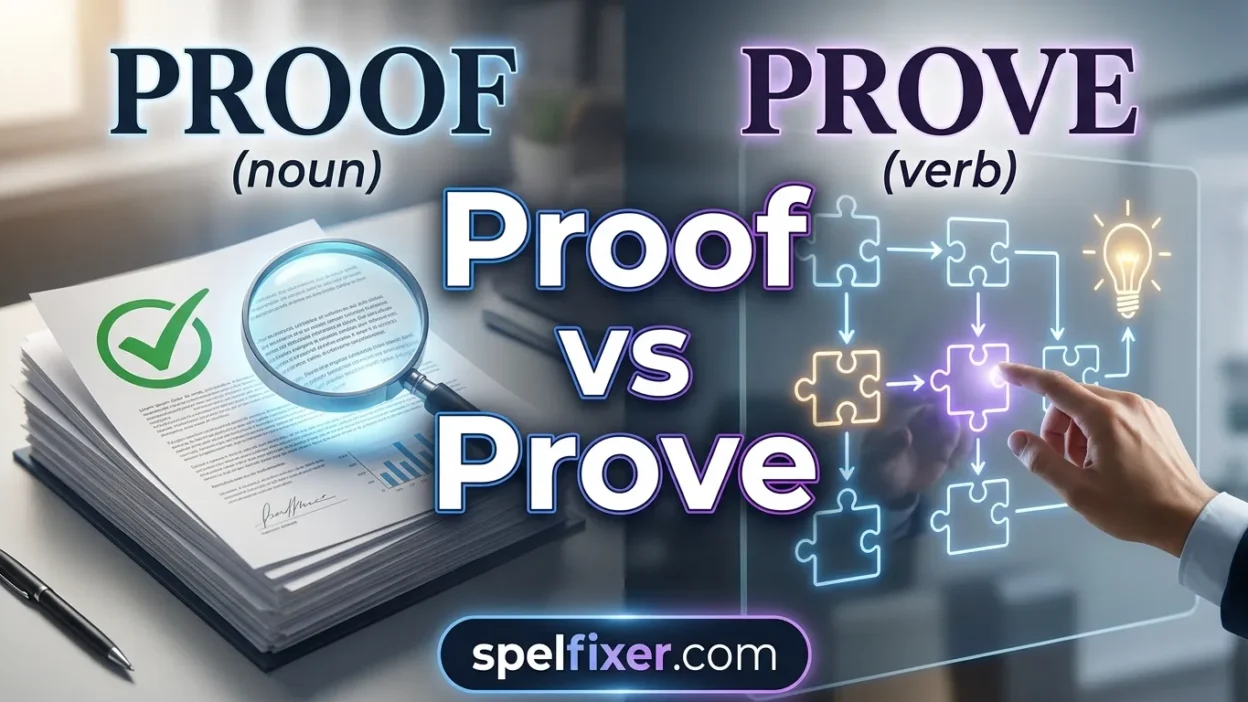
If you’ve ever wondered whether to write proof or prove, you’re not alone. These two words are closely related, but they do different jobs in a sentence. Choosing the wrong one can make your writing sound unnatural or grammatically incorrect.
The good news is that the difference between proof vs prove is simple once you understand their parts of speech. In this guide, I’ll explain their meanings, show you practical examples, compare them side by side, and point out common mistakes so you can confidently use proof and prove in everyday English.
Quick Answer:
Proof is usually a noun meaning evidence or information that shows something is true.
Prove is a verb meaning to demonstrate or establish that something is true.
- Proof = evidence
- Prove = demonstrate with evidence
Quick examples
- I need proof that you were there.
- Can you prove that you were there?
- The photograph is proof of his claim.
- The photograph helps prove his claim.
A simple trick is to ask yourself: Am I talking about evidence, or am I talking about the action of showing something is true?
If it’s evidence, use proof. If it’s the action, use prove.
What Does Proof Mean?
Proof is primarily a noun. It refers to evidence, facts, information, or something else that demonstrates that a statement, claim, or idea is true or correct.
In simple terms, proof is what you have to support something.
For example:
The email is proof that she contacted the company.
Here, the email is the evidence. Therefore, proof is the correct word.
Common meanings of proof
Depending on the context, proof can refer to:
- Evidence that something is true
- Facts supporting a claim
- Demonstration of correctness
- A document or object that confirms something
- Evidence used in mathematics or science
Examples of proof in sentences
- We found proof of the mistake.
- Do you have proof of payment?
- Her message was proof that she knew about the situation.
- The scientist presented proof to support the theory.
- There was not enough proof to support the claim.
- The photograph provides proof of what happened.
Notice that proof names the evidence rather than describing the action of demonstrating something.
What Does Prove Mean?
Prove is a verb. It means to demonstrate, establish, or show that something is true, correct, valid, or genuine.
In simple language, to prove something means to show that it is true.
For example:
Can you prove your statement?
Here, prove describes an action. Someone is being asked to demonstrate that their statement is true.
Examples of prove in sentences
- Can you prove your claim?
- The evidence helped prove his innocence.
- She worked hard to prove that she was capable.
- Scientists try to prove their hypotheses through evidence.
- The results proved that the method worked.
- He wants to prove that the accusation is false.
The verb can change according to tense:
- Prove — present
- Proved — past
- Proven — past participle in many contexts
For example:
She wants to prove her point.
She proved her point yesterday.
Her ability has been proven through years of experience.
Proof vs Prove: The Main Difference
The easiest way to understand proof vs prove is to remember their grammatical roles.
| Word | Part of Speech | Basic Meaning | Example |
| Proof | Noun | Evidence that something is true | This document is proof. |
| Prove | Verb | Show that something is true | I can prove my claim. |
| Proved | Verb | Showed something was true | She proved her point. |
| Proven | Past participle/adjective | Shown to be true or effective | It is a proven method. |
Think of the relationship like this:
Proof = the evidence
Prove = the action of using evidence to establish something
For example:
The receipt is proof of purchase.
The receipt can prove that you made the purchase.
The meaning is connected, but the grammatical function is different.
Proof vs Prove Examples in Everyday English
Seeing the words in realistic situations makes the distinction much easier.
At school
- The student provided proof of his answer.
- The student had to prove that his answer was correct.
At work
- The report provides proof of the problem.
- The manager asked the team to prove their results.
In an argument
- Do you have any proof for your argument?
- Can you prove what you’re saying?
In science
- The researchers searched for proof supporting the theory.
- The researchers attempted to prove their hypothesis.
In everyday conversation
- That photo is proof that we visited the museum.
- I can prove that we visited the museum.
These examples demonstrate an important pattern: proof is something you possess, provide, find, or present, while prove is something you do.
Common Mistakes With Proof and Prove
Because these words have similar meanings, they’re easy to mix up. Here are some of the most common errors.
Mistake 1: Using proof as a verb
❌ I will proof that he is wrong.
✅ I will prove that he is wrong.
When you mean “demonstrate that something is true,” use prove.
Mistake 2: Using prove as a noun
❌ I need prove that you paid.
✅ I need proof that you paid.
Because you need evidence, the noun proof is appropriate.
Mistake 3: Confusing proof with evidence
Proof and evidence are closely related, but they aren’t always perfectly interchangeable.
Evidence is information or material that supports a conclusion. Proof can imply stronger or more conclusive evidence, especially in mathematics and formal reasoning.
For example:
The police found evidence.
The mathematical proof establishes the theorem.
In everyday English, however, people often use proof to mean evidence that confirms something.
Mistake 4: Confusing “proof” with “proven”
❌ This is a proof method.
✅ This is a proven method.
Here, proven means demonstrated to be effective or reliable.
Proof vs Prove in Formal and Academic English
The distinction becomes particularly important in academic writing.
In mathematics, a proof is a logical argument that establishes the truth of a mathematical statement.
For example:
The mathematician presented a proof of the theorem.
You could also use the verb:
The mathematician proved the theorem.
Notice the pattern:
A proof is the logical argument.
Prove describes the act of establishing the result.
In academic writing, it’s also useful to remember that proof may sound stronger than evidence. Depending on the field, writers may prefer words such as evidence, support, demonstrate, or establish when absolute certainty isn’t possible.
Proof vs Prove in American and British English
There is no major difference between American and British English when it comes to the basic meanings of proof and prove.
Both varieties use:
- Proof as a noun
- Prove as a verb
- Proved as a past-tense form
- Proven as a past participle or adjective
For example, both American and British speakers naturally say:
Do you have proof?
and
Can you prove it?
One small usage difference you may encounter involves the past participle proven. American English frequently uses proven in expressions such as:
A proven strategy
British English also uses proven, so this isn’t a strict regional difference.
The safest approach is to focus on grammar and sentence meaning rather than dialect.
How to Remember the Difference
Here’s an easy memory trick:
Proof = thing
Think of proof as a thing you can have, show, provide, or find.
I have proof.
Prove = action
Think of prove as an action you perform.
I can prove it.
You can also remember this simple formula:
Proof → evidence
Prove → demonstrate
If you can replace the word with evidence, proof is probably correct.
If you can replace it with demonstrate, prove is probably correct.
Related Words: Proved, Proven, and Proof
Understanding related forms makes your vocabulary stronger.
Proved
Proved is the simple past form of prove.
She proved that her answer was correct.
Proven
Proven is commonly used as a past participle and adjective.
The technique is proven to be effective.
Both proved and proven can appear in different grammatical constructions, although usage varies by context.
Proof
Proof is the noun.
We need proof before making a decision.
These words belong to the same word family but shouldn’t be used interchangeably.
Frequently Asked Questions
Is proof a noun or a verb?
Proof is primarily a noun. It refers to evidence or information that establishes that something is true. In specialized contexts, “proof” can have other uses, but for everyday grammar, think of it as a noun.
Is prove a noun or a verb?
Prove is a verb. It describes the action of demonstrating that something is true, correct, valid, or genuine.
What is the difference between proof and prove?
Proof is evidence that supports or establishes something, while prove means to demonstrate or establish that something is true.
I have proof.
I can prove it.
Can I say “proof that”?
Yes. Proof that is a very common construction.
This document is proof that the payment was made.
You can also use proof of:
This document is proof of payment.
Is “prove” the same as “proof”?
No. They are related words, but they have different grammatical functions. Proof is generally a noun, while prove is a verb.
Which is correct: “I need proof” or “I need prove”?
I need proof is correct when you mean evidence.
I need proof that you’re telling the truth.
“I need prove” is incorrect in standard English.
Which is correct: “I can proof it” or “I can prove it”?
I can prove it is correct when you mean “I can demonstrate that it is true.”
What is the difference between proof and evidence?
Both can refer to information supporting a conclusion. However, evidence can be broader and may simply support a claim, while proof often suggests evidence strong enough to establish something as true, particularly in mathematics or formal reasoning.
Summary:
The difference between proof vs prove becomes straightforward when you focus on grammar. Proof is a noun that refers to evidence, confirmation, or a demonstration that supports a claim.
Prove is a verb describing the action of showing that something is true, correct, or valid. They come from the same word family but serve different purposes in a sentence.
When you’re unsure which word to choose, ask yourself whether you’re talking about the evidence or the action of demonstrating something. If you’re talking about evidence, choose proof.
If you’re describing the action of demonstrating it, choose prove. This simple distinction will help you avoid one of the most common word-choice mistakes in English.
Actionable Takeaway
Remember this one-line rule:
Proof is what you have; prove is what you do.
Before submitting an email, essay, article, or social media post, check whether the word is functioning as a noun or verb. Once you make that habit, choosing between proof and prove will become almost automatic.