The confusion between discrete vs discreet is incredibly common because these two words look almost identical. In fact, the only visible difference is the placement of two vowels. Despite their similar spelling and pronunciation, they have completely different meanings and are used in very different situations.
If you have ever hesitated before writing “discrete data” or “discreet behavior,” you are not alone. Many English learners, students, professionals, and even native speakers accidentally mix them up. Fortunately, once you understand the meanings and memorize a few simple tricks, choosing the correct word becomes much easier.
In this complete guide, you will learn the meanings of discrete and discreet, how to use them correctly, practical examples, grammar tips, comparison tables, common mistakes, memory tricks, and real-world usage examples that will help improve your writing confidence and accuracy.
Quick Answer
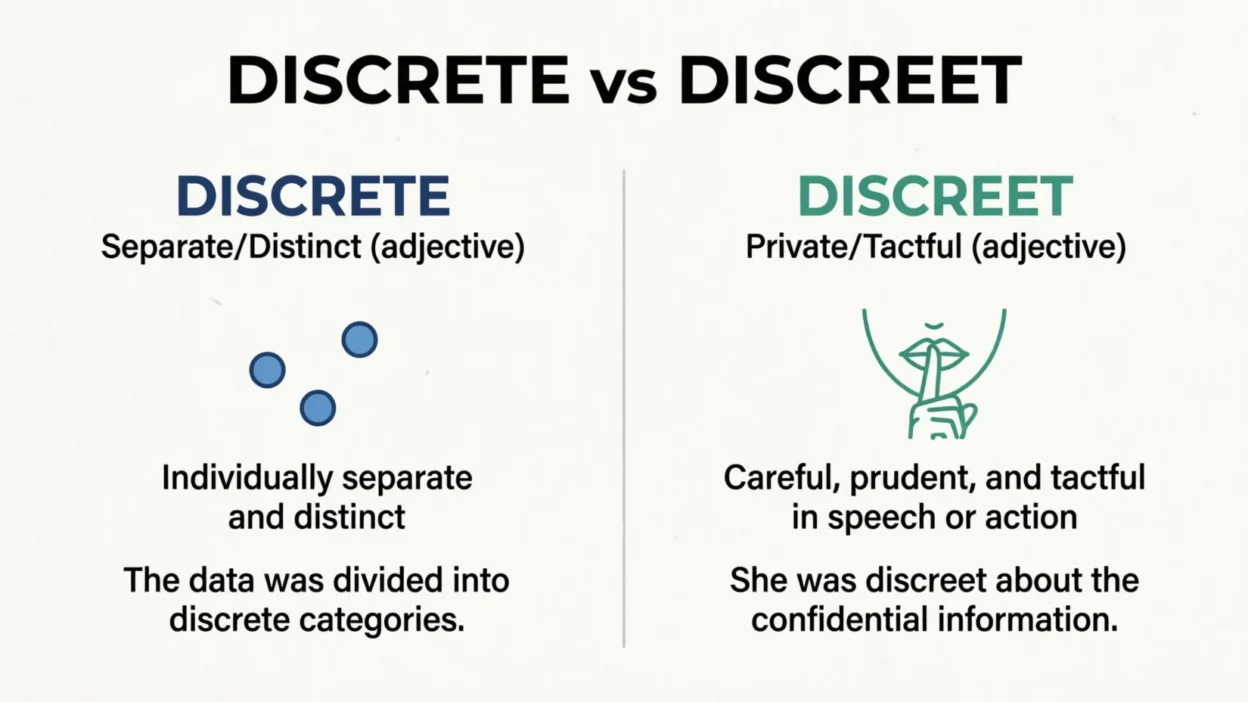
- Discrete means separate, distinct, or individual.
- Discreet means careful, tactful, or intentionally private.
Examples:
- The report divides the information into discrete sections. ✅
- She was discreet about the conversation. ✅
Simple rule:
- Discrete = separate
- Discreet = careful and private
What Does “Discrete” Mean?
“Discrete” describes something that is:
- separate
- individual
- distinct
- disconnected from other parts
It is often used in:
- mathematics
- technology
- science
- business
- data analysis
Examples of Discrete
- The project has three discrete stages.
- Scientists analyzed discrete data points.
- The company operates through several discrete departments.
- Each issue should be treated as a discrete problem.
In all these examples, the items are separated or distinct from one another.
What Does “Discreet” Mean?
“Discreet” refers to someone or something that is:
- careful
- tactful
- subtle
- private
- cautious in speech or behavior
It is commonly used when discussing:
- confidentiality
- manners
- professionalism
- personal conduct
Examples of Discreet
- He was discreet about the client’s information.
- She gave me a discreet warning.
- The hotel offers discreet security services.
- They handled the matter in a discreet manner.
Discrete vs Discreet Comparison Table
| Word | Meaning | Common Context | Example |
|---|---|---|---|
| Discrete | Separate or distinct | Math, science, organization | The data exists in discrete categories |
| Discreet | Careful or private | Behavior, communication | She remained discreet during the meeting |
The Core Difference Between Discrete and Discreet
The easiest way to understand the difference is by remembering their functions.
Discrete = Separate Things
Think:
- individual parts
- disconnected units
- distinct categories
Example:
- The course is divided into discrete modules.
Discreet = Careful Behavior
Think:
- privacy
- tact
- quiet professionalism
Example:
- He made a discreet comment.
How to Use “Discrete” Correctly
Use “discrete” when discussing separate elements or clearly divided parts.
Common Uses of Discrete
- discrete mathematics
- discrete variables
- discrete categories
- discrete systems
- discrete sections
Correct Examples
- The app contains several discrete functions.
- Researchers examined discrete measurements.
- The issues are discrete and should be solved separately.
- Each chapter discusses a discrete topic.
How to Use “Discreet” Correctly
Use “discreet” when describing behavior that avoids attention or protects privacy.
Common Uses of Discreet
- discreet conversation
- discreet service
- discreet behavior
- discreet handling
- discreet investigation
Correct Examples
- The assistant was discreet with confidential files.
- Please be discreet about the surprise party.
- He asked a discreet question during the interview.
- Luxury hotels often provide discreet customer service.
Common Mistakes With Discrete vs Discreet
These words are easy to confuse because of their nearly identical spelling.
Mistake 1: Using Discreet for Separate Objects
Incorrect:
- The system has discreet categories. ❌
Correct:
- The system has discrete categories. ✅
Why?
The sentence refers to separate groups, not careful behavior.
Mistake 2: Using Discrete for Private Behavior
Incorrect:
- She was discrete about the rumor. ❌
Correct:
- She was discreet about the rumor. ✅
Why?
The sentence describes tact and privacy.
Mistake 3: Guessing Based on Pronunciation
Because both words sound very similar, many writers rely on pronunciation alone and accidentally choose the wrong spelling.
Practical Example Paragraphs
Example Using Discrete
Modern software systems often divide tasks into discrete modules to improve organization and efficiency. Each component performs a specific function without interfering with the others.
Example Using Discreet
A discreet professional knows how to handle sensitive information respectfully and privately. This quality is especially important in healthcare, law, customer service, and business leadership.
Placement and Grammar Rules Table
| Phrase | Sentence Placement | Tone/Formality | Example Sentence |
|---|---|---|---|
| Discrete categories | Middle/end | Technical/formal | The data falls into discrete categories |
| Discrete units | Middle | Academic/professional | The machine contains discrete units |
| Discreet conversation | Middle/end | Professional/polite | They had a discreet conversation |
| Discreet handling | Beginning/middle | Formal/business | Discreet handling protects privacy |
American vs British English Differences
There are no major spelling differences between American and British English regarding:
- discrete
- discreet
Both varieties use the same spellings and meanings.
In Both Variations
Correct:
- discrete variables
- discreet behavior
Easy Memory Tricks for Discrete vs Discreet
Trick 1: Discreet Has “EE”
The double “ee” in:
- discreet
can remind you of:
- eyes watching carefully
- keeping secrets quietly
Trick 2: Discrete Means Separate
Think of the letter:
- “t”
as dividing things into distinct parts.
Example:
- discrete categories
Why These Words Matter in Professional Writing
Using the correct word improves:
- credibility
- grammar accuracy
- reader trust
- professional communication
Confusing them may:
- weaken clarity
- confuse readers
- create embarrassing mistakes
This matters especially in:
- academic papers
- business communication
- legal writing
- technical documentation
- marketing content
Similar English Word Confusions
People who search for “discrete vs discreet” often also confuse:
- affect vs effect
- farther vs further
- breath vs breathe
- complement vs compliment
- elude vs allude
These commonly confused words usually have:
- similar pronunciation
- close spelling
- very different meanings
Everyday Examples of Discrete and Discreet
Correct Uses of Discrete
- The scientist recorded discrete values.
- The company has discrete business units.
- Each stage of the process is discrete.
- The software separates information into discrete files.
Correct Uses of Discreet
- She remained discreet during negotiations.
- The doctor was discreet about patient information.
- They chose a discreet location for the meeting.
- He offered discreet assistance.
Incorrect Examples
- She made a discrete comment. ❌
- The report contains discreet sections. ❌
FAQs About Discrete vs Discreet
What is the difference between discrete and discreet?
“Discrete” means separate or distinct, while “discreet” means careful, tactful, or private.
Is discrete used in mathematics?
Yes. “Discrete” is commonly used in math, computer science, and statistics.
Does discreet mean secretive?
Not exactly. It means careful and respectful about privacy or sensitive information.
How do you remember discrete vs discreet?
Use this memory trick:
- discreet = private behavior
- discrete = separate parts
Is discreet a compliment?
Usually, yes. Calling someone discreet suggests professionalism and tact.
Can discrete describe people?
Rarely. “Discrete” usually describes objects, categories, or systems.
Are discrete and discreet pronounced differently?
Their pronunciations are very similar, which is why many people confuse them.
Final Thoughts
Understanding the difference between discrete vs discreet can significantly improve your grammar accuracy and writing confidence. Although these words look and sound similar, their meanings are completely different. “Discrete” refers to separate things, while “discreet” describes careful and private behavior.
Mastering commonly confused words like these helps your writing appear more polished, professional, and trustworthy. Whether you are writing emails, essays, reports, or online content, choosing the correct word strengthens communication and clarity.

Fenwick Quentin is a creative blogging author known for his analytical yet engaging writing style.
He explores topics such as innovation, digital culture, and personal development with depth and clarity.
Through his articles, Fenwick encourages readers to think critically and embrace continuous growth.