Many English speakers accidentally use deep-seeded when they actually mean deep-seated. Because the two phrases sound very similar, this mix-up has become extremely common in everyday conversation, blog writing, business communication, and even professional publications.
If you have ever paused while writing phrases like “deep-seated fears” or “deep-seeded beliefs,” you are not alone. The confusion usually happens because “seeded” feels logical when talking about ideas or emotions growing over time. However, standard English grammar treats these expressions differently.
In this guide, you will learn the real difference between deep-seeded vs deep-seated, which version is grammatically correct, why people confuse them, common mistakes, practical examples, memory tricks, and expert writing tips to help you use the correct phrase confidently.
Quick Answer
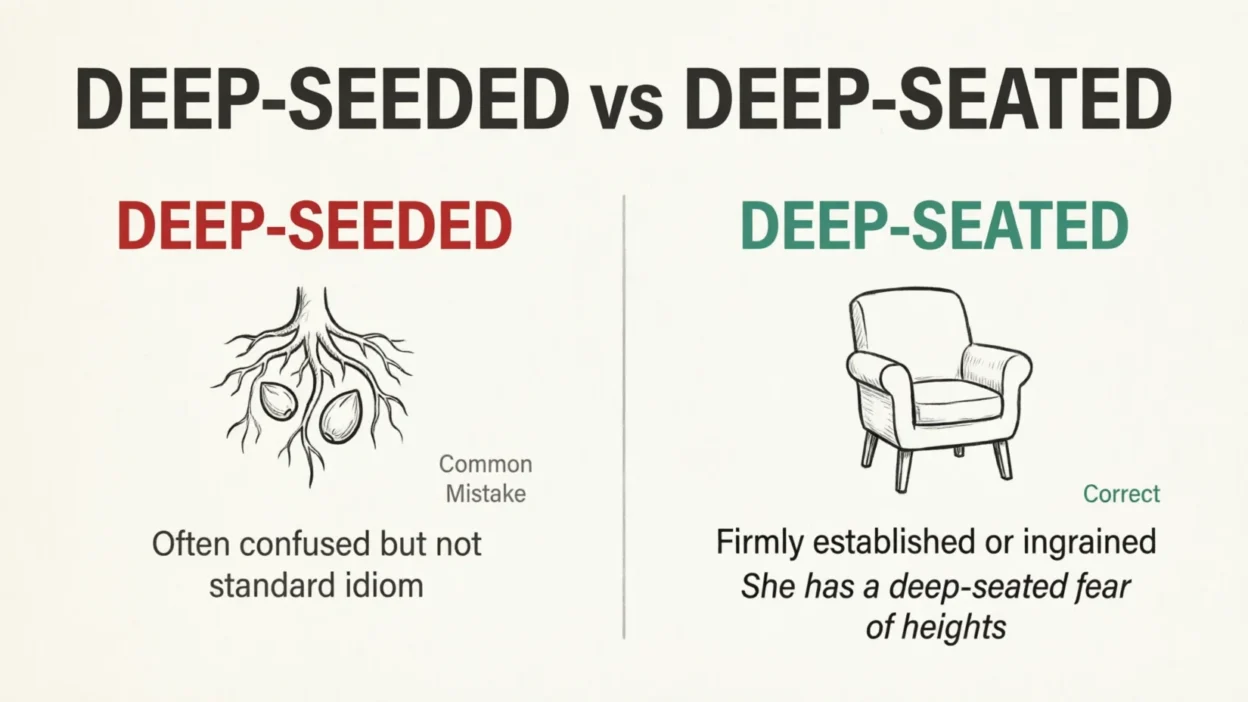
- Deep-seated is the correct and standard English phrase.
- Deep-seeded is usually considered a mistaken version or eggcorn.
- She has deep-seated fears about failure. ✅
Incorrect example:
- She has deep-seeded fears about failure. ❌
What Does “Deep-Seated” Mean?
“Deep-seated” means:
- firmly established
- strongly rooted
- difficult to change
- emotionally ingrained
The phrase is commonly used to describe:
- beliefs
- emotions
- habits
- prejudice
- fears
- traditions
Examples of Deep-Seated
- He has deep-seated trust issues.
- Their rivalry comes from deep-seated resentment.
- The country struggles with deep-seated corruption.
- She developed deep-seated anxiety after the accident.
In all these examples, the feelings or problems are deeply embedded and long-lasting.
What Does “Deep-Seeded” Mean?
Technically, deep-seeded is not considered the standard expression in formal English. Most dictionaries and grammar experts classify it as an incorrect variation of:
- deep-seated
However, many people use “deep-seeded” because it sounds connected to:
- seeds growing underground
- planted emotions or beliefs
This mistaken but understandable substitution is called an eggcorn in linguistics.
Deep-Seeded vs Deep-Seated Comparison Table
| Phrase | Correctness | Meaning | Common Usage |
|---|---|---|---|
| Deep-seated | Correct standard phrase | Firmly established | Formal and informal English |
| Deep-seeded | Usually incorrect | Misheard variation | Common spoken mistake |
Why People Say “Deep-Seeded”
The confusion happens because “seeded” feels emotionally logical.
People naturally associate:
- ideas
- emotions
- fears
- beliefs
with seeds growing over time.
For example:
- deep-seeded trauma
sounds visually meaningful because trauma can “grow” emotionally like a planted seed.
But historically and grammatically, the correct phrase remains:
- deep-seated
The Origin of “Deep-Seated”
The phrase comes from the word:
- seated
meaning:
- settled firmly in place
So “deep-seated” literally describes something positioned deeply within a person, system, or situation.
The expression dates back centuries and became widely used in:
- literature
- psychology
- politics
- journalism
- academic writing
How to Use Deep-Seated Correctly
Use “deep-seated” when discussing:
- emotions
- social problems
- beliefs
- attitudes
- fears
- long-standing issues
Correct Examples
- The community faces deep-seated inequality.
- She has deep-seated confidence issues.
- Their deep-seated friendship lasted decades.
- The organization struggles with deep-seated cultural problems.
Common Situations Where Deep-Seated Appears
Emotional Contexts
- deep-seated anger
- deep-seated anxiety
- deep-seated trauma
Social Issues
- deep-seated racism
- deep-seated corruption
- deep-seated inequality
Personal Habits
- deep-seated routines
- deep-seated beliefs
- deep-seated insecurities
Common Mistakes With Deep-Seeded vs Deep-Seated
This phrase confusion appears frequently online and in casual speech.
Mistake 1: Using Deep-Seeded in Formal Writing
Incorrect:
- The company has deep-seeded issues. ❌
Correct:
- The company has deep-seated issues. ✅
Mistake 2: Assuming Seeded Is More Logical
Many writers think:
- seeded = planted
So they assume it must be correct.
However, English usage standards still prefer:
- deep-seated
Mistake 3: Mixing Both Forms
Incorrect:
- His opinions are deeply seeded in tradition. ❌
Correct:
- His opinions are deeply seated in tradition. ✅
Practical Example Paragraphs
Example Using Deep-Seated
Many people carry deep-seated fears that affect their confidence and decision-making. These emotional patterns often develop slowly through life experiences and can take years to overcome.
Example Using Deep-Seeded
Although some people casually say “deep-seeded beliefs,” professional editors and grammar experts still recommend using “deep-seated beliefs” in formal writing.
Placement and Grammar Rules Table
| Phrase | Sentence Placement | Tone/Formality | Example Sentence |
|---|---|---|---|
| Deep-seated fear | Middle/end | Neutral/formal | She has deep-seated fears |
| Deep-seated issues | Middle | Professional | The company faces deep-seated issues |
| Deep-seated prejudice | Beginning/middle | Academic/formal | Deep-seated prejudice harms society |
| Deep-seeded beliefs | Informal misuse | Informal/nonstandard | He mentioned deep-seeded beliefs |
Is Deep-Seeded Ever Acceptable?
In casual conversation, many people say:
- deep-seeded
and listeners still understand the intended meaning.
However, in:
- academic writing
- professional communication
- journalism
- business documents
- SEO articles
you should almost always use:
- deep-seated
Using the standard phrase improves credibility and professionalism.
American vs British English Differences
There is no major difference between American and British English regarding this phrase.
Both varieties overwhelmingly prefer:
- deep-seated
In both regions:
- deep-seeded is generally viewed as incorrect or nonstandard.
Easy Memory Tricks
Trick 1: Think “Seated Firmly”
Imagine a chair deeply fixed into the ground.
That helps you remember:
- deep-seated = firmly established
Trick 2: Formal Writing Uses Deep-Seated
If writing professionally, always choose:
- deep-seated
This is the safest and most accepted option.
Similar English Confusions
People who search for “deep-seeded vs deep-seated” also commonly confuse:
- per se vs per say
- breath vs breathe
- laying vs lying
- past vs passed
- affect vs effect
These errors happen because spoken English often influences spelling choices.
Why Correct Usage Matters
Using the correct phrase improves:
- writing clarity
- professional credibility
- grammar accuracy
- reader trust
Incorrect wording can:
- distract readers
- weaken authority
- create editing issues
- reduce content quality
This is especially important for:
- bloggers
- students
- marketers
- business professionals
- content writers
Everyday Examples of Deep-Seated
Correct Usage
- The nation faces deep-seated economic problems.
- Her deep-seated fear of rejection affected relationships.
- The argument revealed deep-seated resentment.
- They discussed deep-seated cultural traditions.
Incorrect Usage
- He has deep-seeded anxiety. ❌
- Their deep-seeded prejudice caused conflict. ❌
FAQs About Deep-Seeded vs Deep-Seated
Which is correct: deep-seeded or deep-seated?
“Deep-seated” is the correct standard English phrase.
Why do people say deep-seeded?
People associate emotions and beliefs with seeds growing over time, making the phrase sound logical.
Is deep-seeded grammatically wrong?
In formal English, it is generally considered incorrect or nonstandard.
What does deep-seated mean?
It means firmly established, emotionally ingrained, or difficult to change.
Is deep-seated used in professional writing?
Yes. It is widely accepted in academic, business, and professional communication.
Is deep-seeded ever acceptable?
It may appear in casual speech, but most editors recommend avoiding it in formal writing.
What is an eggcorn?
An eggcorn is a mistaken phrase substitution that sounds logical, like “deep-seeded” instead of “deep-seated.”
Final Thoughts
Understanding the difference between deep-seeded vs deep-seated can instantly improve your writing accuracy and professionalism. Although “deep-seeded” sounds reasonable to many speakers, “deep-seated” remains the correct and widely accepted expression in standard English.
Whether you are writing essays, articles, emails, or professional documents, using “deep-seated” helps your communication sound polished, credible, and grammatically correct. Small language choices like this make a noticeable difference in clear writing.
Actionable Takeaway
Use this quick rule:
- deep-seated = correct
- deep-seeded = commonly mistaken
Easy memory trick:
- think of something firmly “seated” deep inside
When writing professionally, always choose:
- deep-seated beliefs
- deep-seated fears
- deep-seated problems
That simple habit will strengthen your grammar and writing confidence immediately.